
Subaru Ascent 2018-2026 Owner's Manual: Selection of manual mode
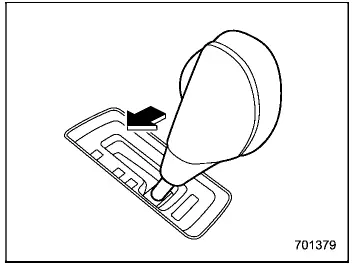
In the Subaru Ascent, manual mode allows the driver to take direct control over gear selection for a more engaging and responsive driving experience. Whether the vehicle is stationary or in motion, you can activate this mode by moving the select lever from the "D" (Drive) position to the "M" (Manual) position.
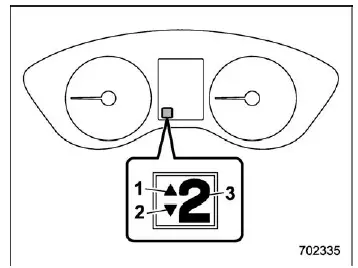
- Upshift indicator
- Downshift indicator
- Gear position indicator
Once manual mode is engaged in the Subaru Ascent, the instrument cluster will display the current gear along with upshift and/or downshift indicators. These visual cues assist the driver in determining the optimal moment to change gears for efficiency or performance.
The gear position indicator displays the selected gear within a simulated 1st-to-8th
gear range. When the upshift indicator "
 "
is illuminated, it signals that shifting to a higher gear is appropriate. When the
downshift indicator "
"
is illuminated, it signals that shifting to a higher gear is appropriate. When the
downshift indicator "
 "
appears, the driver can safely shift to a lower gear. If both indicators are visible,
either shift direction is acceptable depending on driving conditions.
"
appears, the driver can safely shift to a lower gear. If both indicators are visible,
either shift direction is acceptable depending on driving conditions.
When the Subaru Ascent comes to a complete stop, such as at a traffic light, the transmission automatically returns to 1st gear, and the downshift indicator will turn off since no further downshifting is required.
Gear changes in manual mode are performed using the shift paddles located behind the steering wheel, offering quick and intuitive control.
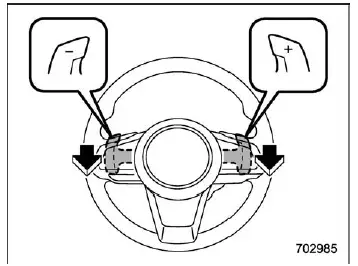
To shift to a higher gear in the Subaru Ascent, pull the paddle marked with a "+". To shift to a lower gear, pull the paddle marked with a "-". This paddle-based control allows smooth and immediate gear transitions without removing your hands from the steering wheel.
To exit manual mode and return to fully automatic operation, simply move the select lever from the "M" position back to the "D" position.
CAUTION
Avoid placing or hanging any objects on the Subaru Ascent shift paddles, as this may cause unintended gear changes and compromise driving safety.
NOTE
Keep the following important points in mind when operating the Subaru Ascent in manual mode.
- If a downshift is attempted at excessively high engine speeds—where the tachometer would exceed the safe redline—the system will emit warning beeps and prevent the shift to protect the engine.
- If you attempt to upshift at very low vehicle speeds, the Subaru Ascent transmission may not respond until conditions are suitable.
- Skip-shifting is possible by pulling the shift paddle multiple times in quick succession (for example, shifting directly from 4th to 2nd gear).
- The transmission automatically selects 1st gear when the Subaru Ascent comes to a complete stop.
- If the transmission fluid temperature becomes too high, the "AT OIL TEMP"
warning light will illuminate on the instrument panel.
In such a situation, stop the Subaru Ascent safely, allow the engine to idle, and wait until the warning light turns off before continuing to drive.
The manual mode in the Subaru Ascent provides enhanced control and flexibility, making it especially useful in situations such as driving on steep terrain, towing, or when more precise vehicle response is required.
 Select lever
Select lever positions
Select lever button
: With the brake pedal depressed, shift while pressing the select lever button in.
: Shift while pressing the select lever button i ...
 Shift lock function
The shift lock mechanism in the Subaru Ascent is designed to enhance safety by
preventing unintended or incorrect operation of the select lever. This system ensures
that gear changes occur only un ...
Other materials:
Dtc c2511 torque sensor main
POWER ASSISTED SYSTEM (POWER STEERING) (DIAGNOSTICS) > Diagnostic Procedure with Diagnostic Trouble Code (DTC)DTC C2511 TORQUE SENSOR MAINTrouble symptom:• The steering wheel operation feels heavy.• STEERING warning light illuminates.Wiring diagram:Electric power steering system Elec ...
Inspection
INSTRUMENTATION/DRIVER INFO > Steering SwitchINSPECTION1. Measure the resistance between switch terminals.Preparation tool:Circuit testerTerminal No.Inspection conditionsStandard3 — 2 (UP)i/SET (DOWN)All OFFApprox. 1 M? or more (UP)ONLess than 1 ?i/SETONApprox. 1,000 ? (DOWN)ONApprox. 3,670 ?2. ...
Dtc b2785 lin communication
KEYLESS ACCESS WITH PUSH BUTTON START SYSTEM (DIAGNOSTICS) > Diagnostic Procedure with Diagnostic Trouble Code (DTC)DTC B2785 LIN COMMUNICATIONDTC detecting condition:When the keyless access CM detected the collation system LIN bus communication error three times in a row.Trouble symptom:The keyl ...
