
Subaru Ascent 2018-2026 Owner's Manual: Braking
Braking tips
WARNING
Avoid keeping your foot resting on the brake pedal while driving the Subaru Ascent. This can cause excessive heat buildup in the braking system and accelerate wear of brake components, reducing braking efficiency.
When the brakes get wet
When driving the Subaru Ascent in rainy conditions or immediately after washing the vehicle, moisture may accumulate on the brake components. This can temporarily increase stopping distances. To restore normal braking performance, drive at a safe speed and apply light, steady pressure to the brake pedal to generate heat and dry the brake system.
Use of engine braking
In addition to using the brake pedal, the Subaru Ascent allows effective use of engine braking to help control speed, especially when descending hills. Relying solely on the foot brake during long downhill driving can lead to overheating of the brake pads and brake fluid, reducing braking effectiveness. To avoid this, shift to a lower gear or use manual mode to increase engine braking and maintain better control.
Braking when a tire is punctured
If a tire on the Subaru Ascent becomes punctured while driving, avoid sudden or forceful braking. Abrupt braking can cause loss of vehicle stability and control. Instead, maintain a firm grip on the steering wheel, continue straight ahead, and gradually reduce speed. Carefully guide the Subaru Ascent to a safe location off the road before stopping completely.
The Subaru Ascent braking and steering systems are engineered to provide a balanced combination of safety, responsiveness, and durability, but proper driving habits and awareness are essential to ensure maximum effectiveness in all road conditions.
Brake system
Two separate circuits
The Subaru Ascent is equipped with a dual-circuit braking system designed to enhance safety and redundancy. Each circuit operates diagonally across the vehicle, ensuring that even if one circuit fails, the other remains functional. In such a situation, braking performance is reduced — the brake pedal will travel closer to the floor and require significantly more force. As a result, the stopping distance of the Subaru Ascent will increase, and extra caution must be exercised while driving.
Electronic brake booster
The Subaru Ascent utilizes an advanced electronic brake booster system that amplifies braking force and improves pedal responsiveness. This system ensures efficient braking under normal conditions.
Never turn off the ignition while the Subaru Ascent is in motion, as doing so will disable the brake booster and greatly reduce braking effectiveness.
Even if the brake booster system stops functioning, the braking system of the Subaru Ascent will still operate. However, much greater pedal effort will be required, and stopping distances will become noticeably longer.
NOTE
During normal operation of the Subaru Ascent, you may occasionally hear sounds from the electronic brake booster control module. These sounds are part of standard system operation and do not indicate a malfunction.
- When the brake pedal is pressed.
- When the driver’s door is opened.
- When driver assistance systems such as EyeSight are activated.
- Several minutes after the Subaru Ascent engine has been turned off.
Supplemental booster function when pressure fails
If a fault occurs within the braking system, the Subaru Ascent incorporates a supplemental booster function that utilizes hydraulic pressure managed by the Vehicle Dynamics Control (VDC) system.
When this backup function is active, pressing the brake pedal may produce audible sounds or slight vibrations. These sensations are normal and indicate that the Subaru Ascent braking system is compensating to maintain stopping capability.
Brake assist system
WARNING
Do not rely solely on the brake assist system in the Subaru Ascent. It does not increase the overall braking capability beyond the physical limits of the vehicle.
Always maintain safe driving habits, including appropriate speed and sufficient following distance.
CAUTION
In emergency braking situations, continue pressing the brake pedal firmly and consistently to allow the Subaru Ascent brake assist system to provide maximum support.
Brake assist in the Subaru Ascent is a driver-support feature that enhances braking force when the system detects that the driver is not applying sufficient pressure in a panic situation.
The system calculates braking force based on how quickly and forcefully the brake pedal is pressed, helping to achieve optimal stopping performance.
NOTE
When braking suddenly or with strong force in the Subaru Ascent, you may notice the following effects. These are normal and confirm that the brake assist system is operating correctly.
- The brake pedal may feel more sensitive, requiring less effort to produce strong braking force.
- You may hear operational sounds similar to ABS activity coming from the engine compartment.
Disc brake pad wear warning indicators
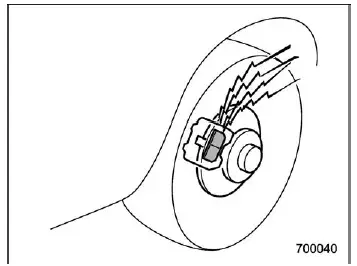
The Subaru Ascent is equipped with brake pad wear indicators that produce a distinct squealing or scraping noise when the brake pads have reached their wear limit.
If such a noise is heard while braking, it is essential to have the Subaru Ascent inspected immediately by a qualified SUBARU dealer to prevent further damage and ensure continued braking safety.
The Subaru Ascent braking system is engineered with multiple layers of safety and redundancy, providing dependable stopping performance even under challenging conditions, but timely maintenance and attentive driving remain critical for optimal safety.
 Power steering
Power steering warning light
Power steering system features
The Subaru Ascent is equipped with a modern electric power steering system designed
to provide precise control, smooth handling, a ...
Other materials:
Operation
VEHICLE DYNAMICS CONTROL (VDC) > ABS Sequence ControlOPERATION1. While the ABS sequence control is being performed, the operation of the hydraulic unit can be checked using the brake tester or pressure gauge after the hydraulic unit solenoid valve operation.2. ABS sequence control can be started ...
Weight
SPECIFICATIONS > CrosstrekWEIGHTModel5 door2.0 L DOHC non-turbo2.0 i5MTCVTOP codeU5C5U5C53A3A3A3ACurb weight (C.W.)Totalkg(lb)1,410(3,109)1,410(3,109)1,445(3,186)1,445(3,186)Frontkg(lb)825(1,819)825(1,819)865(1,907)865(1,907)Rearkg(lb)585(1,290)585(1,290)580(1,279)580(1,279)Gross vehicle weight ( ...
Dtc b1771 buckle switch
OCCUPANT DETECTION SYSTEM (DIAGNOSTICS) > Diagnostic Procedure with Diagnostic Trouble Code (DTC)DTC B1771 BUCKLE SWITCHDIAGNOSIS START CONDITION:Ignition voltage is 8 V to 16 V.DTC DETECTING CONDITION:• Passenger’s seat buckle switch is faulty.• Passenger’s buckle switch ...
