
Subaru Ascent 2018-2026 Owner's Manual: Types of tires
Understanding the types of tires installed on your Subaru Ascent is essential for ensuring optimal safety, handling, and performance in various driving conditions. Each tire category is engineered with specific characteristics that directly affect traction, braking, and overall vehicle stability.
All season tires
All-season tires on your Subaru Ascent are designed to deliver balanced performance throughout the year. They provide a reasonable level of grip, handling stability, and braking efficiency in a wide range of conditions, including light snow and moderately icy roads.
However, while all-season tires offer convenience, they cannot match the superior traction of dedicated winter tires in deep snow or severe icy environments. You can identify all-season tires by markings such as "ALL SEASON" and/or "M+S" (Mud & Snow) on the sidewall.
Summer tires
Summer tires are optimized for high-speed performance and are particularly effective on dry and warm road surfaces. When equipped on your Subaru Ascent, these tires provide excellent responsiveness, grip, and handling precision during highway driving.
However, summer tires are not suitable for cold climates, snow, or icy roads, as their rubber compounds harden at low temperatures, significantly reducing traction. If your Subaru Ascent is driven in winter conditions, it is strongly recommended to switch to winter tires.
When installing winter tires, always replace all four tires to maintain proper balance, traction, and stability of your Subaru Ascent.
Winter (snow) tires
Winter tires are specifically engineered for maximum traction on snow-covered and icy roads. When installed on your Subaru Ascent, they enhance grip, improve braking distance, and increase control under harsh winter conditions.
However, on dry or warm roads, winter tires may not perform as efficiently as all-season or summer tires, and they may wear more quickly. For best results, use them only during the appropriate season.
Tire pressure monitoring system (TPMS)
The Tire Pressure Monitoring System (TPMS) in your Subaru Ascent continuously monitors tire pressure by receiving signals from sensors installed in each wheel. When tire pressure drops significantly, the system alerts the driver through a warning indicator.
The TPMS activates only while the Subaru Ascent is in motion and may not immediately detect rapid pressure loss, such as a sudden puncture caused by road debris.
If tire pressure is adjusted in a warm garage and the vehicle is subsequently driven in colder outdoor conditions, the drop in temperature may lead to reduced tire pressure and activation of the TPMS warning light.
To compensate for this effect, increase tire pressure slightly when adjusting it indoors. As a general guideline, add approximately 1 psi (6.9 kPa, 0.07 kgf/cm²) for every 10°F (5.6°C) difference between indoor and outdoor temperatures.
For example, if your Subaru Ascent tires are set in a 60°F (15.6°C) garage and then driven in significantly colder conditions, a small pressure adjustment can help maintain proper inflation levels.
Example:
Tire size: 245/50R20 102H
Standard tire pressures:
Front: 33 psi (230 kPa, 2.3 kgf/cm2)
Rear: 33 psi (230 kPa, 2.3 kgf/cm2)
Garage temperature: 60°F (15.6°C)
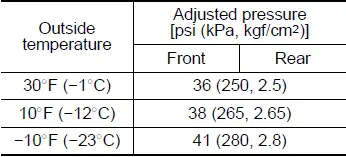
If the TPMS warning light on your Subaru Ascent illuminates after driving in colder air following a pressure adjustment, recheck and adjust the tire pressure accordingly using the recommended method. Then drive at a speed of at least 20 mph (32 km/h) for several minutes to allow the system to recalibrate.
If the warning light does not turn off, this may indicate a malfunction in the tire pressure monitoring system. In such cases, have your Subaru Ascent inspected by an authorized SUBARU dealer as soon as possible to ensure proper system functionality.
Proper tire selection and maintenance play a crucial role in the safety, efficiency, and driving comfort of your Subaru Ascent, especially when adapting to changing weather and road conditions.
While your Subaru Ascent is in motion, friction between the tires and the road surface naturally generates heat, causing the air inside the tires to expand. As a result, tire pressure may temporarily increase during driving. After the low tire pressure warning light has illuminated, this rise in temperature—either from driving or from warmer ambient conditions—can cause the warning light to turn off even if the original issue has not been fully resolved.
When replacing wheels on your Subaru Ascent, it is important to note that not all aftermarket wheels are compatible with TPMS (Tire Pressure Monitoring System) sensors. If you switch to alternative wheels, such as winter tire sets, always select wheels with the same specifications and part numbers as the original equipment to ensure proper TPMS functionality.
If your Subaru Ascent is operated without all four TPMS sensors correctly installed and functioning, the system will not be able to monitor tire pressure accurately. In such cases, the TPMS warning light on the instrument cluster will blink for approximately one minute and then remain steadily illuminated, indicating a system limitation.
WARNING
If the low tire pressure warning light in your Subaru Ascent does not briefly illuminate when the ignition is switched on, or if it remains steadily illuminated after blinking for about one minute, the TPMS may not be operating correctly. Have the system inspected by an authorized SUBARU dealer as soon as possible.
If the warning light activates while driving, do not apply the brakes suddenly. Maintain a straight driving path and gradually reduce speed while keeping full control of your Subaru Ascent. Then carefully pull over to a safe location away from traffic.
Failing to follow these precautions may result in loss of vehicle control, leading to serious damage or injury.
If the warning light remains on after adjusting tire pressure, it may indicate significant tire damage or a rapid air leak. In this situation, replace the affected tire with the spare tire immediately to ensure safe operation of your Subaru Ascent.
If a spare tire is installed or a wheel is replaced without transferring the original TPMS sensor, the warning light will blink for about one minute and then stay illuminated. This indicates that the system cannot monitor all four wheels. Contact your SUBARU dealer promptly for sensor installation, system reset, or necessary repairs.
TPMS valve self-registration
When replacing wheels or installing new TPMS valves on your Subaru Ascent, it is necessary to perform a TPMS self-registration procedure so that the system can recognize the new sensors.
Follow the steps below to complete the TPMS valve registration process.
1. Install the wheels equipped with TPMS valves onto your Subaru Ascent.
2. Adjust the tire pressure of all tires to the specified values. Refer to the "Tires" section for correct pressure specifications.
3. Drive your Subaru Ascent at speeds above 25 mph (40 km/h) for at least 4 miles (6 km), or until the low tire pressure warning light turns off, indicating successful registration.
NOTE
- Always use genuine SUBARU TPMS valves when replacing components to ensure compatibility and reliable system operation.
- TPMS registration can also be performed by a SUBARU dealer using specialized
equipment. If you are unsure about the process, it is recommended to seek professional
assistance.
Consult your SUBARU dealer for expert guidance and service.
Maintaining a properly functioning TPMS in your Subaru Ascent is essential for safe driving, optimal tire performance, and improved fuel efficiency, especially under changing environmental and road conditions.
 Tires and wheels
Proper maintenance of the braking system in your Subaru Ascent, including brake
fluid and brake pads, plays a critical role in overall vehicle safety, ensuring
consistent stopping power and reliab ...
 Tire inspection
Perform a visual inspection of the tires on your Subaru Ascent on a daily basis
to ensure they are free from serious damage, embedded nails, stones, or other foreign
objects. At the same time, car ...
Other materials:
Communication for initializing impossible
KEYLESS ACCESS WITH PUSH BUTTON START SYSTEM (DIAGNOSTICS) > Subaru Select MonitorCOMMUNICATION FOR INITIALIZING IMPOSSIBLENOTE:Confirm that the LAN system is working properly before the diagnosis.Subaru Select Monitor communication line is open or shorted.Detecting condition:• Defective ha ...
Passenger s airbag on/off indicator light illumination pattern Inspection
OCCUPANT DETECTION SYSTEM (DIAGNOSTICS) > Passenger’s Airbag ON/OFF Indicator Light Illumination PatternINSPECTION(1)Passenger’s airbag ON indicator light(6)Light ON(10)OFF(2)Passenger’s airbag OFF indicator light(7)Empty(11)ON(3)Occupant seating(8)Child(12)Approx. 6 sec.(4)Igni ...
Inspection
POWER ASSISTED SYSTEM (POWER STEERING) (DIAGNOSTICS) > General DescriptionINSPECTIONBefore performing diagnosis, check the following items which might be affecting the power steering problem.1. BATTERYCheck the battery. Battery > INSPECTION">2. TIRESCheck the tire specifications, tire ...
