
Subaru Ascent 2018-2026 Owner's Manual: Operating conditions
The Reverse Automatic Braking (RAB) system in the Subaru Ascent is engineered to function only when a specific set of operating conditions is satisfied. These requirements ensure that the system delivers accurate detection and reliable braking assistance while reversing.
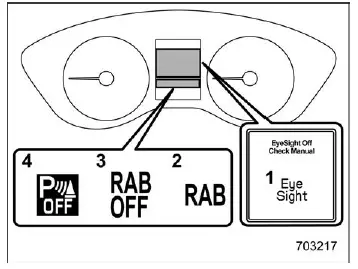
- EyeSight warning indicator
- RAB warning indicator
- RAB OFF indicator
- Sonar Audible Alarm OFF indicator
- The ignition switch of the Subaru Ascent must be in the "ON" position.
- The EyeSight warning indicator must remain off.
- The RAB warning indicator must not be illuminated.
- The RAB OFF indicator must be inactive.
- The select lever must be shifted into the "R" (Reverse) position.
- The Sonar Audible Alarm OFF indicator must be turned off.
Sonar Audible Alarm function
- The Sonar Audible Alarm must be enabled ("ON") in the Subaru Ascent settings.
- The vehicle speed must be within the range of 0 to 9 mph (0 to 15 km/h) for proper detection.
Automatic Braking function
- The Automatic Braking function must be activated ("ON").
- The Subaru Ascent must be reversing at a speed between 1 and 9 mph (1.5 to 15 km/h).
NOTE
- If any of the following warning indicators illuminate, the Reverse Automatic
Braking (RAB) system in the Subaru Ascent will not operate. Immediate inspection
by a SUBARU dealer is required.
- The EyeSight warning indicator is on.
- The RAB warning indicator is on.
- The system cannot operate under the following conditions.
- The
 (EyeSight Temporary Stop indicator: White) is illuminated, indicating a
temporary suspension of EyeSight functions. Refer to the EyeSight manual
for further details.
(EyeSight Temporary Stop indicator: White) is illuminated, indicating a
temporary suspension of EyeSight functions. Refer to the EyeSight manual
for further details. - The RAB OFF indicator is illuminated, indicating the system is manually disabled.
- The
- The following conditions may prevent proper operation of the Subaru
Ascent RAB system. If observed, have the system inspected as soon as possible.
- Presence of stickers, paint, or chemical substances on or near the sonar sensors.
- Modification or deformation of the rear bumper.
- Removal and reinstallation of the rear bumper.
- Changes in ground clearance due to heavy loading or suspension modification.
- Physical damage to the sonar sensors or surrounding bumper area.
- Strong impacts affecting the rear structure of the Subaru Ascent.
- On steep inclines, the braking effectiveness of the RAB system may be reduced.
- The Subaru Ascent RAB system is optimized for low-speed reversing (below approximately 3 mph / 5 km/h) and does not guarantee collision avoidance in all situations.
- At extremely low reversing speeds, driver input may override the system, and automatic braking may not activate.
- The system may struggle to detect the following types of objects.
- Thin or narrow objects such as poles, wires, fences, or ropes.
- Objects located extremely close to the rear bumper when shifting into reverse.
- Surfaces that poorly reflect sonar signals, such as mesh fences.
- The Subaru Ascent RAB system is not designed to detect or react to the
following.
- Pedestrians or animals.
- Moving vehicles or dynamic objects.
- Soft materials like cloth or snow that absorb sound waves.
- Objects with angled or irregular surfaces.
- Low obstacles such as parking blocks or high overhead objects.
- Objects outside the central detection path of the vehicle.
- Non-perpendicular or uneven surfaces.
- During reversing, the system may malfunction or respond incorrectly
under the following influences.
- External high-frequency sounds such as horns, engines, or air brake systems.
- Other vehicles equipped with similar sonar systems operating nearby.
- Severe weather conditions including heavy rain, snow, fog, or sandstorms.
- Strong winds or rapid airflow conditions.
- Attachments or electronic equipment installed near the rear bumper.
- Accumulation of snow, mud, or ice on sensors.
- Vehicle inclination or uneven loading of the Subaru Ascent.
- Environmental limitations may affect system performance.
- Presence of hanging objects such as banners or branches.
- Driving on gravel, grass, or uneven terrain.
- Narrow spaces such as tunnels, garages, or bridges.
- Obstacles like drainage grates, potholes, or uneven surfaces.
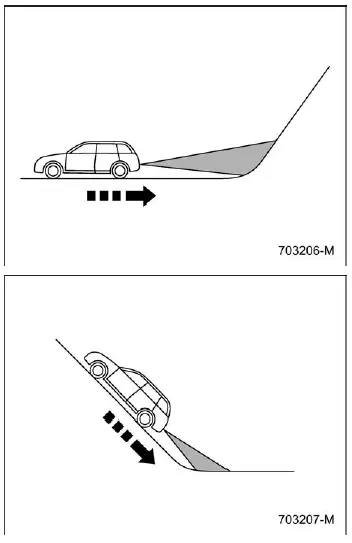
- Reversing uphill on steep inclines may affect detection accuracy.
- Reversing downhill may also reduce system effectiveness.
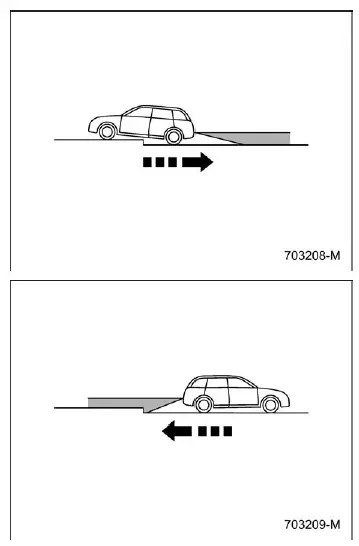
- Curbs, steps, or uneven terrain may interfere with detection.
- Low ceilings in garages or tunnels can affect sensor readings.
- Snow, puddles, or adjacent objects may distort sonar signals.
- Driving close to walls or mixed surfaces (dirt, snow, pavement) may produce inaccurate readings.
- Even when the Subaru Ascent RAB system is operating correctly, collision
avoidance may not be possible in the following situations.
- Slippery or icy road surfaces.
- Incorrect tire pressure.
- Worn or unsuitable tires.
- Use of tire chains.
- Non-standard tire sizes.
- Temporary tire repairs using sealant kits.
- Modified suspension systems.
- Vehicle instability due to damage or malfunction.
- Active brake system warning lights.
When the Reverse Automatic Braking (RAB) system in the Subaru Ascent is actively responding to a potential collision, the driver will hear warning beeps in three distinct levels. These escalating alerts are designed to provide intuitive feedback, allowing the driver to react quickly and safely while reversing.
The Subaru Ascent RAB system enhances reversing safety by combining sensor-based detection with automatic braking assistance, but it should always be complemented by careful driver observation and control.
 Reverse Automatic Braking (RAB) system overview
The Subaru Ascent RAB system operates using four rear-mounted sonar sensors and
provides two primary functions designed to assist the driver during reversing maneuvers.
Sonar Audible Alarm funct ...
 Sonar Audible Alarm function
In the Subaru Ascent, the Reverse Automatic Braking (RAB) system is supported
by an advanced sonar audible alert function designed to enhance driver awareness.
When the system detects a potential ...
Other materials:
Dtc c1222 front left abs sensor signal
VEHICLE DYNAMICS CONTROL (VDC) (DIAGNOSTICS) > Diagnostic Procedure with Diagnostic Trouble Code (DTC)DTC C1222 FRONT LEFT ABS SENSOR SIGNALNOTE:For the diagnostic procedure, refer to “DTC C1242 REAR LEFT ABS SENSOR SIGNAL”. Diagnostic Procedure with Diagnostic Trouble Code (DTC) > ...
Dtc b2222 system microcomputer fail
INSTRUMENTATION/DRIVER INFO (DIAGNOSTICS) > Diagnostic Procedure with Diagnostic Trouble Code (DTC)DTC B2222 SYSTEM MICROCOMPUTER FAILDTC DETECTING CONDITION:When the microcomputer froze.TROUBLE SYMPTOM:MFD does not operate.NOTE:Reset the MFD. If it does not return to the normal operation, replac ...
Dtc u0416 invalid data received from vehicle dynamics control module
HVAC SYSTEM (AUTO A/C) (DIAGNOSTICS) > Diagnostic Procedure with Diagnostic Trouble Code (DTC)DTC U0416 INVALID DATA RECEIVED FROM VEHICLE DYNAMICS CONTROL MODULEThis is detected when CAN data from VDC is abnormal.NOTE:Perform the diagnosis for LAN system. Basic Diagnostic Procedure > PROCEDU ...
