
Subaru Ascent 2018-2026 Owner's Manual: Arming the system
The Subaru Ascent alarm system is automatically armed when a specific sequence of actions is completed, ensuring reliable protection of the vehicle and its contents against unauthorized access.
1. Fully close all windows and the moonroof (if equipped), then turn the ignition switch of your Subaru Ascent to the "OFF" position.
2. Take the Subaru Ascent key or access key fob with you and exit the vehicle.
3. Confirm that the engine hood is securely closed.
4. Lock the Subaru Ascent using any of the following available methods:
- Locking via the remote keyless entry system for quick and convenient access control.
- Using the Subaru Ascent keyless access function (if equipped) by touching the door lock sensor.
- Locking through the interior power door locking switch.
- Using the Subaru Ascent power rear gate lock button for full vehicle locking.
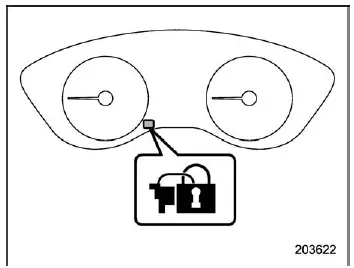
Security indicator light
NOTE
When the Subaru Ascent alarm system is armed, all doors and the rear gate will lock, a single electronic chirp will sound, and the hazard warning lights will flash once. The security indicator light will begin flashing rapidly to indicate that the system is entering standby mode.
5. After approximately 30 seconds, the Subaru Ascent alarm system transitions into full surveillance mode.
Once in surveillance mode, the security indicator light will flash more slowly (approximately twice every 2 seconds), confirming that the Subaru Ascent is fully protected.
NOTE
- The Subaru Ascent alarm system can technically be armed even if windows
or the moonroof are open; however, for maximum security, it is strongly recommended
to close all openings completely.
This ensures proper cabin protection and prevents unauthorized entry.
- If any door or the rear gate of the Subaru Ascent is not fully closed
during arming, the system will issue five warning chirps and flash the hazard
lights five times.
Once the door is properly closed, the Subaru Ascent will automatically lock and arm itself after approximately 30 seconds.
- The default 30-second standby delay can be adjusted or removed by a SUBARU dealer according to your preference.
- If any of the following actions occur during the standby period, the
Subaru Ascent will not enter surveillance mode:
- Unlocking the doors using the key fob or remote transmitter.
- Unlocking via the keyless access system (for equipped models).
- Opening any door or the rear gate.
- Turning the ignition switch to the "ON" position (models without push-button start).
- Switching the push-button ignition to the "ACC" position (models with keyless access).
 Alarm system operation
When the Subaru Ascent alarm system is armed, it will be triggered if any of
the following components are opened without authorization:
Any door
The rear gate
The engine hood
Once trigger ...
 Disarming the system
To deactivate the Subaru Ascent alarm system, perform one of the following procedures:
Press any button on the Subaru Ascent access key fob or remote transmitter
briefly (less than 2 seconds).
...
Other materials:
Turn signal lever
To activate the right turn signal, push the
turn signal lever up. To activate the left
turn signal, push the turn signal lever
down. When the turn is finished, the lever
will return automatically. If the lever does
not return after cornering, return the lever
to the neutral position by han ...
Dtc b1407 met communication
IMMOBILIZER (DIAGNOSTICS) > Diagnostic Procedure with Diagnostic Trouble Code (DTC)DTC B1407 MET COMMUNICATIONDTC DETECTING CONDITION:Communication failure between body integrated unit and combination meterCAUTION:When the combination meter is replaced, registration of the immobilizer system is r ...
Fastening the seatbelt
WARNING
Never use a belt that is twisted or
reversed. In an accident, this can
increase the risk or severity of
injury.
Keep the lap belt as low as
possible on your hips. In a collision,
this spreads the force of the
lap belt over stronger hip bones
instead of across the weaker
...
