
Subaru Ascent 2018-2026 Owner's Manual: Tire labeling
The tires installed on your Subaru Ascent feature a variety of markings on the sidewall, including tire size, Tire Identification Number (TIN), and other important specifications. These markings provide valuable technical information that helps you better understand tire performance, compatibility, and safety requirements for your Subaru Ascent.
Tire size
Your Subaru Ascent is equipped with P-Metric tires, which follow a standardized sizing system widely used for passenger vehicles. Understanding this system is essential when selecting replacement tires to ensure proper fitment, handling, and safety.
P Metric
In the P-Metric system, the tire section width is expressed in millimeters. To convert this measurement into inches, divide the value by 25.4. The aspect ratio, which is the ratio of the tire’s height to its width, provides additional dimensional information and influences ride comfort and handling characteristics of your Subaru Ascent.
Example:
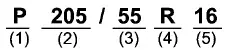
(1) P = Tire classification used for passenger vehicles such as the Subaru Ascent
(2) Section Width in millimeters
(3) Aspect Ratio (= section height divided by section width)
(4) R = Radial tire construction
(5) Rim diameter measured in inches
Load and Speed Rating Descriptions
Following the tire size designation, additional markings indicate load and speed ratings. These values are critical for ensuring that the tires on your Subaru Ascent meet required performance standards.
The numeric value represents the load index, which indicates the maximum load capacity of the tire, while the alphabetical symbol indicates the maximum safe speed rating.
Example:

(6) Load Index: A numerical value that defines the maximum load a tire can safely carry at its rated pressure.
For example, "90" corresponds to 1,323 lbs (600 kg), while "89" represents 1,278 lbs (580 kg).
WARNING
The load index applies only to the tire itself and not to the vehicle. Installing a tire with a higher load rating does not increase the allowable load capacity of your Subaru Ascent.
(7) Speed Rating: A letter code indicating the maximum speed capability of the tire under specified conditions.
For example, a "V" rating corresponds to a maximum speed of 149 mph (240 km/h).
WARNING
- Speed ratings apply exclusively to the tire and do not determine the
maximum speed of your Subaru Ascent.
Installing a high-speed-rated tire does not mean the vehicle can be safely driven at that speed.
- The speed rating becomes invalid if the tire is excessively worn, damaged, repaired, retreaded, or otherwise modified from its original condition. Such tires may no longer safely support their original load and speed specifications.
Tire Identification Number (TIN)
The Tire Identification Number (TIN) is stamped on the outer sidewall and provides detailed information about the tire’s origin and manufacturing date. Understanding this code helps determine the age and traceability of tires used on your Subaru Ascent.
Type A

(1) DOT symbol*
(2) Manufacturer's Identification Mark
(3) Tire Size Code
(4) Tire Type Code
(5) Date of Manufacture
The first two digits indicate the production week (01–52), and the last two digits represent the year of manufacture. For example, "0101" indicates the first week of 2001.
*: The DOT symbol confirms that the tire complies with Federal Motor Vehicle Safety Standards.
Type B

(1) DOT symbol*
(2) Plant Code
(3) Manufacturer's Code
(4) Date of Manufacture
As with Type A, the first two digits represent the week of manufacture, and the last two digits indicate the year.
*: The DOT marking certifies compliance with safety regulations applicable to your Subaru Ascent tires.
Other markings
Additional information is also printed on the tire sidewall to provide further technical details relevant to your Subaru Ascent.
Maximum permissible inflation pressure
This indicates the maximum cold inflation pressure the tire can safely withstand. For example: "300 kPa (44 PSI) MAX. PRESS".
Maximum load rating
This specifies the maximum load the tire can carry at the stated pressure. For example: "MAX. LOAD 580 kg (1,279 LBS) @ 300 kPa (44 PSI) MAX. PRESS."
WARNING
The maximum load rating applies only to the tire. It does not increase the allowable load capacity of your Subaru Ascent.
Construction type
This describes the overall construction of the tire, such as "TUBELESS STEEL BELTED RADIAL", indicating modern radial construction used on your Subaru Ascent.
Construction
This section identifies the materials used in the tire’s internal structure. For example: "PLIES: TREAD 2 STEEL + 2 POLYESTER SIDEWALL 2 POLYESTER".
Uniform Tire Quality Grading (UTQG)
This grading system provides information about treadwear, traction, and temperature resistance. For more detailed explanations, refer to the section on "Uniform tire quality grading standards".
Understanding tire labeling on your Subaru Ascent helps ensure proper tire selection, safe operation, and long-term durability under varying driving conditions.
 Tire information
...
 Recommended tire inflation pressure
Recommended cold tire inflation pressure
To ensure optimal handling, safety, and tire longevity for your Subaru Ascent,
always follow the recommended cold tire inflation pressures specified for you ...
Other materials:
Regarding malfunction
CAUTION
Never leave or store the access
key inside the vehicle or within
6.6 ft (2 m) around the vehicle
(e.g., in the garage). The access
key may be locked inside the
vehicle, or the battery may discharge
rapidly. Note that the
push-button ignition switch may
not turn on in some ...
Dtc b2a06 right speaker/audio circuit
TELEMATICS SYSTEM (DIAGNOSTICS) > Diagnostic Procedure with Diagnostic Trouble Code (DTC)DTC B2A06 RIGHT SPEAKER/AUDIO CIRCUITDiagnosis start condition:When ACC is ON.DTC detecting condition:Speaker impedance is more than 10 k? for 100 ms. (Detached speaker connection, etc.)Trouble symptom:• ...
Removal
BRAKE > Front Brake PadREMOVAL1. Lift up the vehicle, and then remove the front wheels.2. Remove the front brake pad.(1) Remove the caliper bolt on the lower side.(2) Raise the caliper body assembly and support it.NOTE:Do not disconnect the brake hose from the caliper body assembly.(3) Remove the ...
