
Subaru Ascent 2018-2026 Owner's Manual: Recommended tire inflation pressure
Recommended cold tire inflation pressure
To ensure optimal handling, safety, and tire longevity for your Subaru Ascent, always follow the recommended cold tire inflation pressures specified for your vehicle. These values are provided in the "Tires" section and are carefully calibrated for the Subaru Ascent to deliver the best balance between comfort, efficiency, and performance.
Vehicle placard
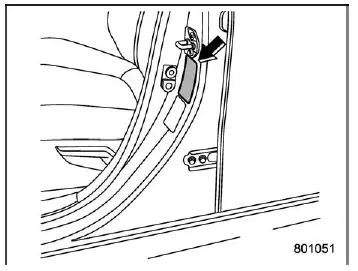
The official vehicle placard for your Subaru Ascent is located on the driver’s side door pillar and serves as the primary reference for correct tire specifications.
Example:
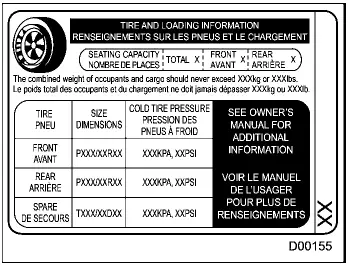
The placard displays important information including the original tire size, the recommended cold inflation pressure for each tire under maximum load conditions, seating capacity, and cargo limits. These values are specifically engineered for the Subaru Ascent and should always be followed when adjusting tire pressure.
Adverse safety consequences of under-inflation
Operating your Subaru Ascent with insufficient tire pressure can lead to serious safety risks. Under-inflated tires flex excessively during driving, generating heat rapidly. This heat buildup can cause structural damage to the tire, including tread separation or sudden tire failure.
Such conditions significantly increase the risk of losing control of your Subaru Ascent, especially at higher speeds, potentially resulting in dangerous driving situations or accidents.
Measuring and adjusting air pressure to achieve proper inflation
To maintain safe and efficient operation of your Subaru Ascent, check the tire pressure of all tires—including the spare—at least once a month and before any extended trip.
Always measure tire pressure when the tires are cold, meaning the vehicle has been stationary for several hours or driven only a short distance. Use a reliable tire pressure gauge to adjust each tire to the specified values indicated on the vehicle placard.
Keep in mind that even short-distance driving can warm up the tires, causing internal air expansion and temporarily increasing pressure. Ambient temperature also plays a significant role in tire pressure variation. For the most accurate readings, check tire pressure outdoors before driving your Subaru Ascent.
If a tire has already warmed up, do not release air to reduce pressure, as this may result in under-inflation once the tire cools down. Proper pressure management ensures optimal traction, improved fuel efficiency, and extended tire life for your Subaru Ascent.
Consistently maintaining the correct tire pressure is one of the simplest yet most critical steps in ensuring the long-term safety, performance, and reliability of your Subaru Ascent.
 Tire labeling
The tires installed on your Subaru Ascent feature a variety of markings on the
sidewall, including tire size, Tire Identification Number (TIN), and other important
specifications. These markings p ...
 Glossary of tire terminology
Accessory weight
In the context of your Subaru Ascent, accessory weight refers to the total additional
mass of optional equipment beyond standard components. This includes features such
as a ...
Other materials:
Removal
ENTERTAINMENT > Rearview Camera SystemREMOVAL1. CROSSTREK MODEL1. Disconnect the ground cable from battery. NOTE">2. Remove the trim panel - rear gate. Rear Gate Trim > REMOVAL">3. Remove the arm assembly - rear wiper. Rear Wiper Arm > REMOVAL">4. Remove the motor ...
Daylight saving time setting
1. Perform the preparation steps according
to "Preparation for date setting" 3-
56.
2. Operate the "
" or "
"
switch to
select the "Daylight Saving Time" item.
Then push the
button.
3. The current setting will be displayed.
Push the
button to enter the selection ...
Adjustment
MECHANICAL(H4DO) > Cam ClearanceADJUSTMENT1. Remove the engine from the vehicle. Engine Assembly > REMOVAL">2. Remove the chain cover. Chain Cover > REMOVAL">3. When adjusting #1 and #3 cylinders(1) Remove the timing chain RH. Timing Chain Assembly > REMOVAL">( ...
