
Subaru Crosstrek Service Manual: Inspection
SECURITY AND LOCKS > Relay and Fuse
INSPECTION
1. CHECK FUSE
1. Remove the fuse and inspect visually.
2. If the fuse is blown out, replace the fuse.
NOTE:
If the fuse is blown again, check the system wiring harness.
2. CHECK RELAY
1. Check the resistance between relay terminals.
Terminal No. | Inspection conditions | Standard | Circuit |
1 — 2 | Always | 1 M? or more |
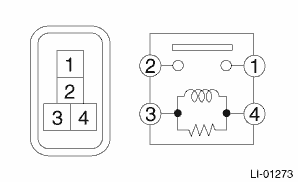
1 — 2
Apply battery voltage between terminals 4 and 3.
Less than 1 ?
Terminal No. | Inspection conditions | Standard | Circuit |
1 — 4 | Always | 1 M? or more |
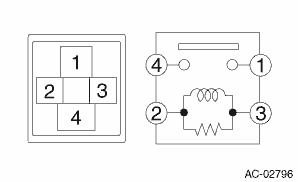
1 — 4
Apply battery voltage between terminals 2 and 3.
Less than 1 ?
Terminal No. | Inspection conditions | Standard | Circuit |
1 — 2 | Always | 1 M? or more |
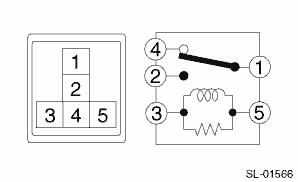
1 — 4
Always
Less than 1 ?
1 — 2
Apply battery voltage between terminals 3 and 5.
Less than 1 ?
2. Replace the relay if the inspection result is not within the standard value.
 Relay and fuse
...
 Location
SECURITY AND LOCKS > Relay and FuseLOCATIONMain fuse boxFuse 15 A (key warning switch, turn signal & hazard unit, body integrated unit)(A)Fuse 20 A (body integrated unit, immobilizer antenna)(B ...
Other materials:
Brake fluid level warning
This light illuminates when the brake fluid
level has dropped to near the "MIN" level
of the brake fluid reservoir with the ignition
switch in the "ON" position and with the
parking brake fully released.
If the brake system warning light should
illuminate while driving (with the parking
bra ...
Installation
EXTERIOR/INTERIOR TRIM > Side GarnishINSTALLATIONCAUTION:Do not reuse the garnish assembly. Deformation occurs on the garnish assembly when once removed, and this may cause improper adhesion.1. Install each part in the reverse order of removal.2. Install the garnish assembly - fender and the garn ...
List of diagnostic trouble code (dtc) List
BODY CONTROL SYSTEM (DIAGNOSTICS) > List of Diagnostic Trouble Code (DTC)LISTDTCItemContent of diagnosisNoteB1010BODY CONTROL SYSTEM (BIU) MALFUNCTIONBody integrated unit internal error Diagnostic Procedure with Diagnostic Trouble Code (DTC) > DTC B1010 BODY CONTROL SYSTEM (BIU) MALFUNCTION&qu ...
