
Subaru Crosstrek Service Manual: Inspection
SEAT BELT SYSTEM > Rear Seat Belt
INSPECTION
1. VISUAL INSPECTION
Check for the following, and replace with new parts if necessary.
• Seat belt is slackened, bent or worn.
• Seat belt is abnormally wound or extended.
• Seat belt inner - rear is deformed or damaged.
• Seat belt buckle cannot be engaged properly.
2. ELR LOCK MECHANISM INSPECTION
1. Hold the retractor upright (as installed in the vehicle) and check the ELR lock mechanism.
2. Tilt the retractor from the upright posture and check the following points.
• It does not lock if the inclination angle is 15° or less.
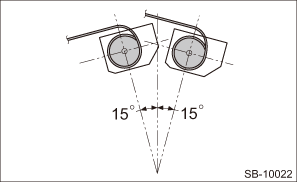
• It remains locked if the inclination angle is 27° or more.
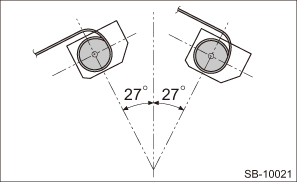
3. If the ELR lock mechanism does not operate properly, replace the seat belt outer - rear with a new part.
 Rear seat belt
...
 Removal
SEAT BELT SYSTEM > Rear Seat BeltREMOVAL1. SEAT BELT OUTER - REAR RH & LHCAUTION:• Airbag system satellite safing sensor is located in the lower of the rear seat cushion center. Be carefu ...
Other materials:
Clear memory mode Operation
KEYLESS ACCESS WITH PUSH BUTTON START SYSTEM (DIAGNOSTICS) > Clear Memory ModeOPERATION1. On «Start» display, select «Diagnosis».2. On «Vehicle selection» display, input the target vehicle information and select «Confirmed».3. On «Main Menu» display, select «Each System».4. On «Selec ...
Adjustment
CONTROL SYSTEMS > Select CableADJUSTMENT1. Shift the select lever to “N” range.2. Lift up the vehicle.3. Remove the center exhaust pipe. Center Exhaust Pipe > REMOVAL">4. Remove the center exhaust cover.5. Loosen the adjusting nuts on both sides.(A)Adjusting nut A(B)Adjust ...
Inspection
FUEL INJECTION (FUEL SYSTEMS)(H4DO) > Electronic Throttle Control RelayINSPECTION1. Check that the electronic throttle control relay has no deformation, cracks or other damages.2. Measure the resistance between electronic throttle control relay terminals.Terminal No.Standard1 and 21 M? or more3 a ...
