
Subaru Crosstrek Service Manual: Inspection
MECHANICAL(H4DO) > Cam Clearance
INSPECTION
1. WHEN TIMING CHAIN ASSEMBLY IS NOT REMOVED
CAUTION:
When working on the vehicle, if engine oil is spilt onto the exhaust pipe, wipe it off with cloth to avoid emission of smoke or causing a fire.
NOTE:
• Inspection of cam clearance should be performed while engine is cold.
• If the engine is removed from vehicle, performing the steps 1) to 2) is not necessary.
1. Disconnect the ground cable from battery. NOTE">
2. Remove the V-belts. V-belt > REMOVAL">
3. When inspecting #1 and #3 cylinders
(1) Remove the rocker cover RH. Rocker Cover > REMOVAL">
NOTE:
When working on the vehicle, place a suitable container under the vehicle.
(2) Set #1 cylinder piston to top dead center of compression stroke by rotating the crank pulley clockwise using the socket wrench.
NOTE:
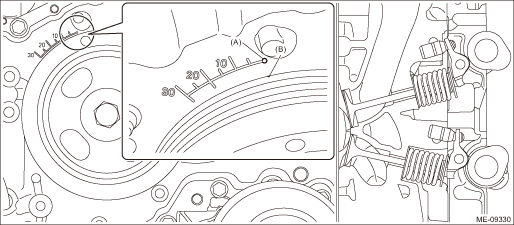
When the timing mark (B) on crank pulley is aligned to the 0° in timing gauge (A) on chain cover as shown in the figure, the #1 cylinder piston is located at TDC of compression stroke if the intake camshaft and exhaust camshaft does not depress the #1 cylinder intake side roller rocker arm (intake valve) and exhaust side roller rocker arm (exhaust valve). If roller rocker arm (valve) is depressed, turn the crank pulley by 360° in order to make #1 cylinder piston at TDC of compression stroke.
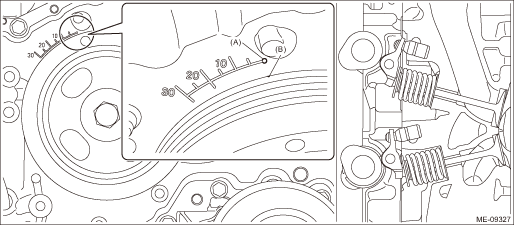
(3) Check the cam clearance for #1 cylinder intake, #1 cylinder exhaust and #3 cylinder exhaust.
NOTE:
• Measure the roller surface of cam base circle and roller rocker arm using thickness gauge (A).
• If the measured value is out of standard, take notes of the value in order to adjust the cam clearance later on.
Cam clearance:
Intake
Standard
0.13+0.02 −0.03 mm (0.0051+0.0008 −0.0012 in)
Exhaust
Standard
0.22±0.02 mm (0.0087±0.0008 in)
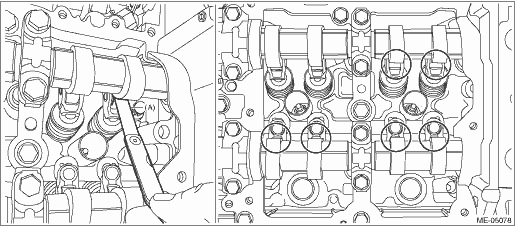
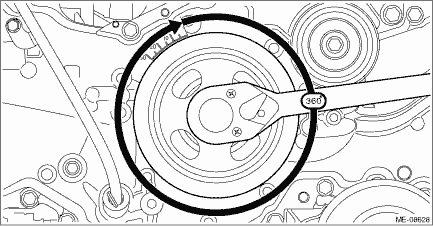
(4) Turn the crank pulley by 360°.
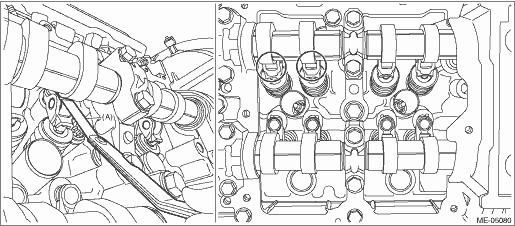
(5) Check the cam clearance of #3 cylinder intake.
NOTE:
• Measure the roller surface of cam base circle and roller rocker arm using thickness gauge (A).
• If the measured value is out of standard, take notes of the value in order to adjust the cam clearance later on.
Cam clearance:
Standard
0.13+0.02 −0.03 mm (0.0051+0.0008 −0.0012 in)
4. When inspecting #2 and #4 cylinders
(1) Remove the rocker cover LH. Rocker Cover > REMOVAL">
NOTE:
When working on the vehicle, place a suitable container under the vehicle.
(2) Set #2 cylinder piston to top dead center of compression stroke by rotating the crank pulley clockwise using the socket wrench.
NOTE:
When the timing mark (B) on crank pulley is aligned to the 0° in timing gauge (A) on chain cover as shown in the figure, the #2 cylinder piston is located at TDC of compression stroke if the intake camshaft and exhaust camshaft does not depress the #2 cylinder intake side roller rocker arm (intake valve) and exhaust side roller rocker arm (exhaust valve). If roller rocker arm (valve) is depressed, turn the crank pulley by 360° in order to make #2 cylinder piston at TDC of compression stroke.
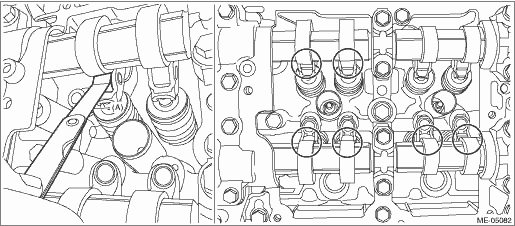
(3) Check the cam clearance for #2 cylinder intake, #2 cylinder exhaust and #4 cylinder exhaust.
NOTE:
• Measure the roller surface of cam base circle and roller rocker arm using thickness gauge (A).
• If the measured value is out of standard, take notes of the value in order to adjust the cam clearance later on.
Cam clearance:
Intake
Standard
0.13+0.02 −0.03 mm (0.0051+0.0008 −0.0012 in)
Exhaust
Standard
0.22±0.02 mm (0.0087±0.0008 in)
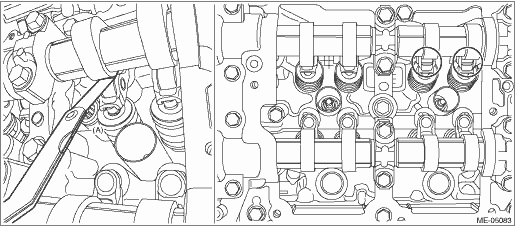
(4) Turn the crank pulley by 360°.
(5) Check the cam clearance of #4 cylinder intake.
NOTE:
• Measure the roller surface of cam base circle and roller rocker arm using thickness gauge (A).
• If the measured value is out of standard, take notes of the value in order to adjust the cam clearance later on.
Cam clearance:
Standard
0.13+0.02 −0.03 mm (0.0051+0.0008 −0.0012 in)
5. If necessary, adjust the cam clearance. Cam Clearance > ADJUSTMENT">
6. After inspection, install the related parts in the reverse order of removal.
2. WHEN TIMING CHAIN ASSEMBLY IS REMOVED
NOTE:
Inspection of cam clearance should be performed while engine is cold.
1. When inspecting #1 and #3 cylinders
(1) Remove the rocker cover RH. Rocker Cover > REMOVAL">
NOTE:
When working on the vehicle, place a suitable container under the vehicle.
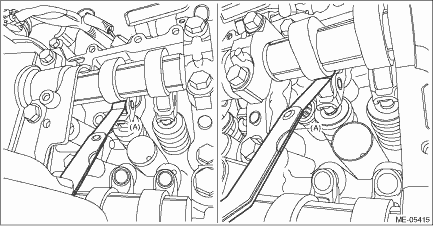
(2) Check the #1 and #3 cylinder cam clearance.
CAUTION:
Intake and exhaust camshafts can be independently rotated with the timing chain removed. When the intake valve and exhaust valve lift at the same time, the valve heads contact each other and valve stem may bend. Do not turn it to the outside of range of zero lift (cam base circle position) (in range where it can be turned lightly by hand).
NOTE:
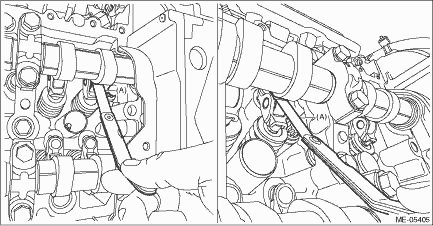
• For cam clearance inspection, adjust the cam base circle position so that the thickness gauge (A) can be inserted easily by hand turning the camshaft (cam sprocket) to be measured.
• Measure the roller surface of cam base circle and roller rocker arm using thickness gauge (A).
• If the measured value is out of standard, take notes of the value in order to adjust the cam clearance later on.
Cam clearance:
Intake
Standard
0.13+0.02 −0.03 mm (0.0051+0.0008 −0.0012 in)
Exhaust
Standard
0.22±0.02 mm (0.0087±0.0008 in)
2. When inspecting #2 and #4 cylinders
(1) Remove the rocker cover LH. Rocker Cover > REMOVAL">
NOTE:
When working on the vehicle, place a suitable container under the vehicle.
(2) Check the #2 and #4 cylinder cam clearance.
CAUTION:
Intake and exhaust camshafts can be independently rotated with the timing chain removed. When the intake valve and exhaust valve lift at the same time, the valve heads contact each other and valve stem may bend. Do not turn it to the outside of range of zero lift (cam base circle position) (in range where it can be turned lightly by hand).
NOTE:
• For cam clearance inspection, adjust the cam base circle position so that the thickness gauge (A) can be inserted easily by hand turning the camshaft (cam sprocket) to be measured.
• Measure the roller surface of cam base circle and roller rocker arm using thickness gauge (A).
• If the measured value is out of standard, take notes of the value in order to adjust the cam clearance later on.
Cam clearance:
Intake
Standard
0.13+0.02 −0.03 mm (0.0051+0.0008 −0.0012 in)
Exhaust
Standard
0.22±0.02 mm (0.0087±0.0008 in)
3. If necessary, adjust the cam clearance. Cam Clearance > ADJUSTMENT">
4. After inspection, install the related parts in the reverse order of removal.
 Adjustment
MECHANICAL(H4DO) > Cam ClearanceADJUSTMENT1. Remove the engine from the vehicle. Engine Assembly > REMOVAL">2. Remove the chain cover. Chain Cover > REMOVAL">3. When adjusti ...
 Cam sprocket
...
Other materials:
Using the voice command system
Steering switch
Talk switch
Action
Function
Press
Start the voice command
system.
Press and hold
Cancel voice recognition.
Microphone
Type A
Type B
It is unnecessary to speak directly into the
microphone when giving a command.
NOTE
Wait ...
Dtc c1531 bls off stuck
VEHICLE DYNAMICS CONTROL (VDC) (DIAGNOSTICS) > Diagnostic Procedure with Diagnostic Trouble Code (DTC)DTC C1531 BLS OFF STUCKDTC detecting condition:Defective stop light switchTrouble symptom:• ABS does not operate.• VDC does not operate.• Hill start assist does not operate.WIRI ...
Dtc u0428 invalid data received from steering angle sensor module
LAN SYSTEM (DIAGNOSTICS) > Diagnostic Procedure with Diagnostic Trouble Code (DTC)DTC U0428 INVALID DATA RECEIVED FROM STEERING ANGLE SENSOR MODULEDTC DETECTING CONDITION:Defective data was transmitted from steering angle sensor.TROUBLE SYMPTOM:VDC CM does not operate normally.STEPCHECKYESNO1.CHE ...
