
Subaru Crosstrek Service Manual: Inspection
CLUTCH SYSTEM > Clutch Disc and Cover
INSPECTION
1. CLUTCH DISC
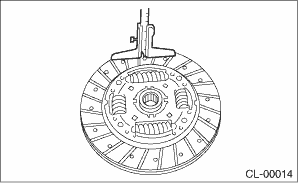
1. Facing wear
Measure the depth from the facing surface to the rivet head. Replace if the face is worn locally or worn down to less than the specified value.
Depth to rivet head:
Limit of sinking
0.8 mm (0.031 in)
NOTE:
Do not wash the clutch disc with any type of cleaning fluid.
2. Hardened facing
Replace the clutch disc.
3. Oil soakage on facing
Replace the clutch disc and inspect the transmission front oil seal, transmission case mating surface, engine rear oil seal and other locations for oil leakage.
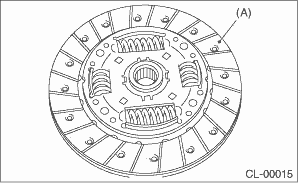
(A) | Clutch facing |
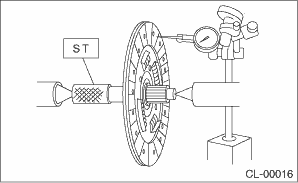
4. Deflection on facing
If deflection exceeds the specified value at the outer circumference of the facing, replace the clutch disc.
| ST 499747100 | CLUTCH DISC GUIDE |
Limit for deflection:
0.7 mm (0.028 in) at R = 110 mm (4.33 in)
5. If there is spline wear, loose rivets, failed damper springs, etc., replace the clutch disc.
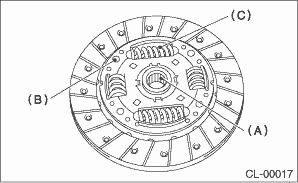
(A) | Spline |
(B) | Rivet |
(C) | Damper spring |
2. CLUTCH COVER
NOTE:
Visually check the following items without disassembling, and replace or repair if defective.
1. Loose thrust rivet
2. Damaged or worn bearing contact area at the center of diaphragm spring

(A) | Thrust rivet |
(B) | Diaphragm spring |
3. Damaged or worn disc contact surface of the pressure plate
4. Loose strap plate installation area
5. Worn diaphragm sliding area
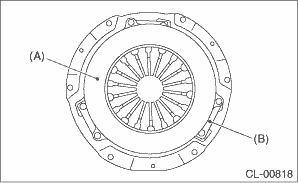
(A) | Pressure plate |
(B) | Strap plate |

 Removal
CLUTCH SYSTEM > Clutch Disc and CoverREMOVAL1. Remove the transmission assembly from the vehicle. Manual Transmission Assembly > REMOVAL">2. Attach the ST on the flywheel.ST 499747100 ...
Other materials:
Removal
EMISSION CONTROL (AUX. EMISSION CONTROL DEVICES)(H4DO) > PCV ValveREMOVALCAUTION:Do not remove unless the PCV valve is broken.1. Disconnect the PCV hose from the intake manifold and the PCV valve, and then remove the PCV hose.2. Remove the clip (A) holding the air breather hose from the engine ha ...
Removal
CONTINUOUSLY VARIABLE TRANSMISSION(TR580) > Primary Speed SensorREMOVALCAUTION:Be sure to prevent water or oil from contacting the connector terminal of primary speed sensor. If adhesion occurs, replace with a new part.1. Remove the transmission assembly. Automatic Transmission Assembly > REM ...
Dtc u0423 invalid data received from instrument panel cluster control module
HVAC SYSTEM (AUTO A/C) (DIAGNOSTICS) > Diagnostic Procedure with Diagnostic Trouble Code (DTC)DTC U0423 INVALID DATA RECEIVED FROM INSTRUMENT PANEL CLUSTER CONTROL MODULEThis is detected when CAN data from meter is abnormal.NOTE:Perform the diagnosis for LAN system. Basic Diagnostic Procedure &g ...
