
Subaru Crosstrek Service Manual: Brake line Inspection
PERIODIC MAINTENANCE SERVICES > Brake Line
INSPECTION
1. BRAKE LINE
1. Check for scratches, swelling, corrosion, traces of fluid leakage on the brake hoses or pipe joints.
2. Make sure that brake pipes/hoses do not interfere with adjacent parts and there is no loose connector/clamp during driving.
3. Check any trace of fluid leakage, scratches, etc. on master cylinder, wheel cylinder and hydraulic unit.
NOTE:
• When the brake fluid level in the reservoir tank is lower than specified limit, the brake warning light on the combination meter will illuminate.
• Visually check the brake hose for damage. (Use a mirror where it is difficult to see)
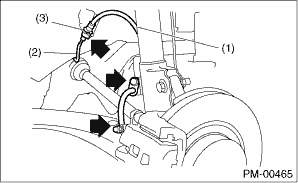
(1) | Front brake hose |
(2) | Front brake pipe |
(3) | Clamp |
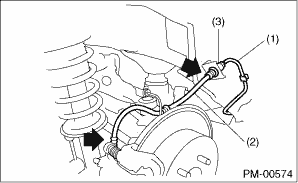
(1) | Brake pipe |
(2) | Rear brake hose |
(3) | Clamp |
2. SERVICE BRAKE
Refer to “BR” section for foot brake inspection. Brake Pedal > INSPECTION">
3. BRAKE SERVO SYSTEM
1. With the engine off, depress the brake pedal several times applying the same pedal force. Check that the travel distance should not change.
2. With the brake pedal depressed, start the engine. Check that the pedal moves slightly toward the floor.
3. With the brake pedal depressed, stop the engine and keep the pedal depressed for 30 seconds. Check that the pedal height does not change.
4. A check valve is built into the brake booster nipple. Disconnect the vacuum hose to inspect function of check valve.
Check that check valve ventilates from booster side to engine side. Also, check that there is no ventilation from engine side to booster side.
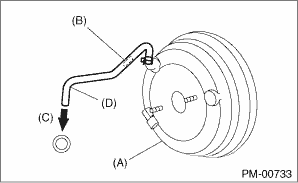
(A) | Brake booster |
(B) | Check valve |
(C) | Engine side |
(D) | Vacuum hose |
5. Check the vacuum hose for cracks or other damage.
CAUTION:
When installing the vacuum hose on the engine and brake booster, do not use soapy water or lubricating oil on their connections.
6. Check that the vacuum hose is securely tightened.
 Axle boots joints Inspection
PERIODIC MAINTENANCE SERVICES > Axle Boots & JointsINSPECTION1. FRONT AND REAR AXLE BOOTSInspect the front axle boots (A) and rear axle boots (B) for deformation, damage or failure. If faulty, ...
 Clutch system Inspection and adjustment
PERIODIC MAINTENANCE SERVICES > Clutch SystemINSPECTION AND ADJUSTMENTRefer to “CL” section for inspection and adjustment of clutch system. Clutch Pedal > INSPECTION"> Clut ...
Other materials:
Removal
GLASS/WINDOWS/MIRRORS > Remote Control Mirror SwitchREMOVAL1. Disconnect the ground cable from battery and wait for at least 60 seconds before starting work. NOTE">2. Remove the trim panel - front door. Door Trim > REMOVAL">3. Remove the panel - power window main switch. Pow ...
Steering responsive fog lights warning indicator/ Steering responsive fog
lights OFF indicator (models with EyeSight system)
NOTE
For details about the steering responsive
fog lights system, refer to "Steering
responsive fog lights system (models
with EyeSight system)"
Steering responsive fog lights
warning indicator
This indicator appears when the steering
responsive fog lights system malfunctions.
When this ...
Read current data Operation
OCCUPANT DETECTION SYSTEM (DIAGNOSTICS) > Read Current DataOPERATIONCheck the operating condition of each sensor in the event of malfunction in the seat belt buckle switch, or when the seat belt buckle switch has been replaced.NOTE:For detailed operation procedures, refer to “Application he ...
