
Subaru Crosstrek Owners Manual: Vehicle load limit - how to determine
The load capacity of your vehicle is determined by weight, not by available cargo space. The load limit of your vehicle is shown on the vehicle placard attached to the driver's side door pillar. Locate the statement "The combined weight of occupants and cargo should never exceed XXX kg or XXX lbs" on your vehicle's placard.
The vehicle placard also shows seating capacity of your vehicle.
The total load capacity includes the total weight of driver and all passengers and their belongings, any cargo, any optional equipment such as a trailer hitch, roof rack or bike carrier, etc., and the tongue load of a trailer. Therefore cargo capacity can be calculated by the following method.
Cargo capacity = Load limit − (total weight of occupants + total weight of optional equipment + tongue load of a trailer (if applicable)) For information about vehicle loading, refer to "Loading your vehicle" F8-12.
For information about towing capacity and weight limits, refer to "Trailer towing" F8-17.
Calculating total and load capacities varying seating configurations
Calculate the available load capacity as shown in the following examples:
Example 1A
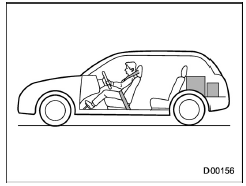
Vehicle capacity weight of the vehicle is 900 lbs (408 kg), which is indicated on the vehicle placard with the statement "The combined weight of occupants and cargo should never exceed 900 lbs or 408 kg".
For example, if the vehicle has one occupant weighing 154 lbs (70 kg) plus cargo weighing 662 lbs (300 kg).
1. Calculate the total weight. 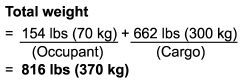
2. Calculate the available load capacity
by subtracting the total
weight from the vehicle capacity
weight of 900 lbs (408 kg). 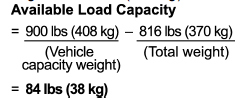
3. The result of step 2 shows that a further 84 lbs (38 kg) of cargo can be carried.
Example 1B
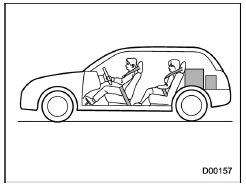
For example, if a person weighing 176 lbs (80 kg) now enters the same vehicle (bringing the number of occupants to two), the calculations are as follows.
1. Calculate the total weight. 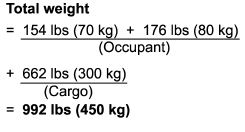
2. Calculate the available load capacity.
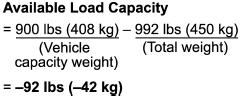
3. The total weight now exceeds the capacity weight by 92 lbs (42 kg), so the cargo weight must be reduced by 92 lbs (42 kg) or more.
Example 2A
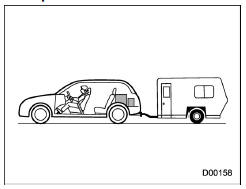
Vehicle capacity weight of the vehicle is 900 lbs (408 kg), which is indicated on the vehicle placard with the statement "The combined weight of occupants and cargo should never exceed 408 kg or 900 lbs".
For example, the vehicle has one occupant weighing 165 lbs (75 kg) plus cargo weighing 375 lbs (170 kg). In addition, the vehicle is fitted with a trailer hitch weighing 22 lbs (10 kg), to which is attached a trailer weighing 1,764 lbs (800 kg).
10% of the trailer weight is applied to the trailer tongue (i.e. Tongue load = 176 lbs (80 kg)).
1. Calculate the total weight. 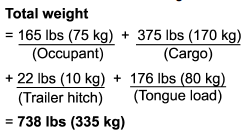
2. Calculate the available load capacity.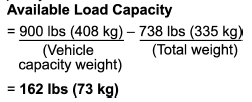
3. The result of step 2 shows that a further 162 lbs (73 kg) of cargo can be carried.
Example 2B
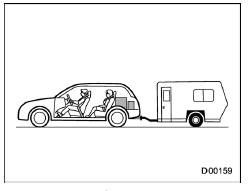
For example, if a person weighing 143 lbs (65 kg) and a child weighing 40 lbs (18 kg) now enter the same vehicle (bringing the number of occupants to three), and a child restraint system weighing 11 lbs (5 kg) is installed in the vehicle for the child to use, the calculations are as follows.
1. Calculate the total weight. 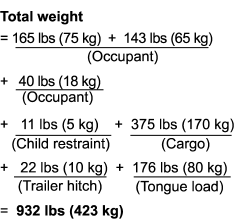
2. Calculate the available load capacity.
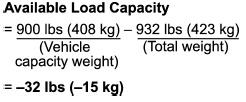
3. The total weight now exceeds the capacity weight by 32 lbs (15 kg), so the cargo weight must be reduced by 32 lbs (15 kg) or more.
 Tire care - maintenance and safety practices
Check on a daily basis that the
tires are free from serious damage,
nails, and stones. At the same time,
check the tires for abnormal wear
Inspect the tire tread regularly
and replace the ...
 Determining compatibility of tire and vehicle load capacities
The sum of four tires' maximum
load ratings must exceed the maximum
loaded vehicle weight
("GVWR"). In addition, sum of the
maximum load ratings of two front
tires and of two rear tires must
exc ...
Other materials:
Periodic inspections
To ensure that your Subaru Ascent remains in peak operating condition throughout
its service life, it is essential to strictly follow the recommended maintenance
schedule. All inspections and servicing procedures outlined in the "Warranty and
Maintenance Booklet" should be carried ou ...
Connecting a smartphone
If you connect a smartphone to this
system after starting a supported aha
application on the smartphone, you can
display and operate the aha application
displayed on the smartphone on the
system screen.
1. Run the aha application on your
smartphone.
2. Connect the iPhone/iPod touch to th ...
Dtc u0422 invalid data received from body control module
KEYLESS ACCESS WITH PUSH BUTTON START SYSTEM (DIAGNOSTICS) > Diagnostic Procedure with Diagnostic Trouble Code (DTC)DTC U0422 INVALID DATA RECEIVED FROM BODY CONTROL MODULEDetected when CAN data from BIU is abnormal.NOTE:Perform the diagnosis for LAN system. Basic Diagnostic Procedure > PROCE ...
