
Subaru Ascent 2018-2026 Owner's Manual: Vehicle load limit - how to determine
The load-carrying capability of your Subaru Ascent is defined by weight limitations rather than available interior or cargo space. The maximum permissible load is clearly indicated on the vehicle placard located on the driver’s side door pillar. On this label, you will find the statement: "The combined weight of occupants and cargo should never exceed XXX kg or XXX lbs," which represents the absolute load limit for your Subaru Ascent.
In addition to load limits, the vehicle placard also specifies the seating capacity, which must always be considered when calculating total weight.
The total load capacity of your Subaru Ascent includes several components: the weight of the driver and all passengers, personal belongings, cargo, installed optional equipment such as roof racks or trailer hitches, and the tongue weight of any attached trailer. Because of this, the available cargo capacity must be calculated carefully using the following formula.
Cargo capacity = Load limit − (total weight of occupants + total weight of optional equipment + trailer tongue load, if applicable)
Calculating total and load capacities varying seating configurations
Below are practical examples demonstrating how to calculate available load capacity for your Subaru Ascent under different conditions.
Example 1A
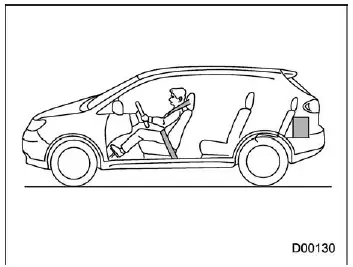
In this example, the Subaru Ascent has a vehicle capacity weight of 900 lbs (408 kg), as indicated on the placard.
Assume there is one occupant weighing 154 lbs (70 kg) and cargo weighing 662 lbs (300 kg).
1. First, determine the total combined weight of the occupant and cargo.
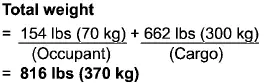
2. Subtract this total from the maximum capacity of 900 lbs (408 kg) to determine the remaining allowable load.
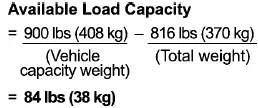
3. The result shows that an additional 84 lbs (38 kg) of cargo can still be safely loaded into the Subaru Ascent.
Example 1B
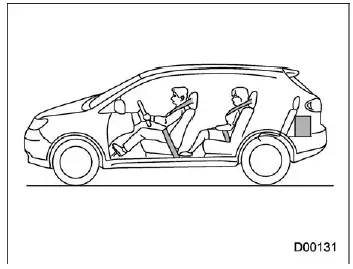
Now consider that another passenger weighing 176 lbs (80 kg) enters the Subaru Ascent.
1. Recalculate the total combined weight.
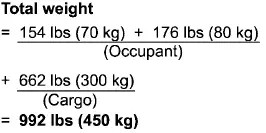
2. Determine the updated available load capacity.
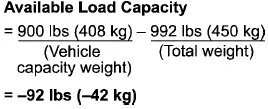
3. The calculation now shows that the load exceeds the permitted capacity by 92 lbs (42 kg). Therefore, the cargo must be reduced by at least this amount to maintain safe operation of the Subaru Ascent.
Example 2A
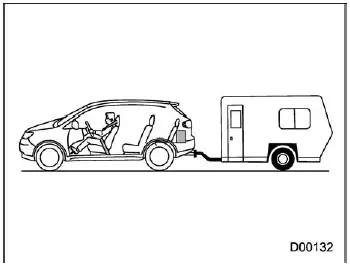
In this scenario, the Subaru Ascent again has a capacity of 900 lbs (408 kg).
The vehicle includes one occupant weighing 165 lbs (75 kg), cargo weighing 375 lbs (170 kg), and optional equipment such as a trailer hitch weighing 22 lbs (10 kg). A trailer weighing 1,764 lbs (800 kg) is attached, with 10% of its weight (176 lbs / 80 kg) applied as tongue load.
1. Calculate the total combined weight, including the trailer tongue load.
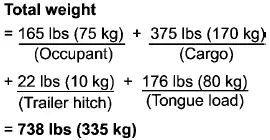
2. Subtract this total from the maximum capacity.
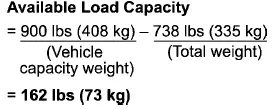
3. The result shows that an additional 162 lbs (73 kg) of cargo can still be safely carried by the Subaru Ascent.
Example 2B
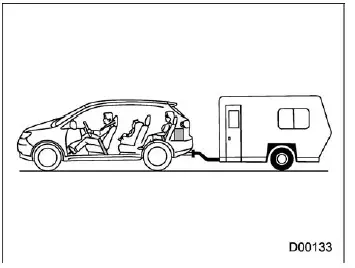
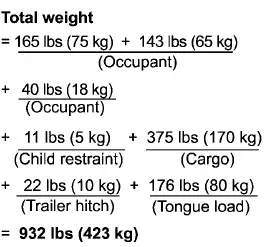
Now consider adding another adult weighing 143 lbs (65 kg), a child weighing 40 lbs (18 kg), and a child restraint system weighing 11 lbs (5 kg).
1. Recalculate the total weight with all occupants and equipment included.
2. Determine the remaining load capacity.
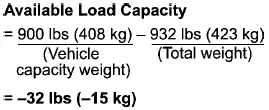
3. The calculation indicates that the total load now exceeds the allowable limit by 32 lbs (15 kg). To maintain safe driving conditions in your Subaru Ascent, cargo must be reduced accordingly.
Understanding and correctly calculating load limits in your Subaru Ascent is essential for maintaining vehicle stability, protecting critical components, and ensuring safe operation under all driving conditions.
 Tire care - maintenance and safety practices
For reliable performance of your Subaru Ascent, inspect the tires ежедневно
or before each drive to ensure they are free from serious damage, embedded objects
such as nails or stones ...
 Uniform tire quality grading standards
The Uniform Tire Quality Grading (UTQG) system provides valuable comparative
information about tire performance, specifically in the areas of treadwear, traction,
and temperature resistance. For S ...
Other materials:
Installation
GLASS/WINDOWS/MIRRORS > Rear Door GlassINSTALLATIONCAUTION:• Check that the running channel - rear door is securely fixed to the panel assembly - rear door and to the sash COMPL - rear partition.• Before installing the glass assembly - rear door, check the lip of the running channel - ...
Operation
INSTRUMENTATION/DRIVER INFO > Combination Meter SystemOPERATION1. SELF-DIAGNOSIS DISPLAY MODEThe self-diagnosis (checking of each meter, warning light, indicator light, illumination, LCD/TFT) of combination meter can be performed in the following procedure.1. ProcedureCAUTION:Perform the steps de ...
Inspection
WIPER AND WASHER SYSTEMS > Washer Tank and MotorINSPECTION1. WASHER PUMPApply battery voltage to the connector terminal of the motor pump assembly - washer, and make sure that the motor operates.2. WASHER FLUID LEVEL SENSOR1. Check the connection status of washer fluid level sensor connector.2. D ...
