
Subaru Ascent 2018-2026 Owner's Manual: SRS side airbag and SRS curtain airbag
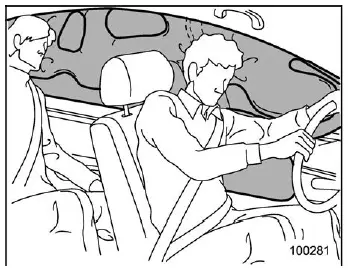
SRS side airbag
The Subaru Ascent is equipped with advanced SRS side airbags that are strategically integrated into the outer side of each front seatback. These airbags are clearly identified by an "SRS AIRBAG" label, ensuring easy recognition of their deployment zones.
In the event of a moderate to severe side collision, the Subaru Ascent SRS side airbag on the impacted side deploys rapidly between the occupant and the door structure. This provides additional protection by reducing the force transmitted to the chest and waist area, working in conjunction with the seatbelt system. The SRS side airbag system is specifically designed to protect front-seat occupants.
SRS curtain airbag
The Subaru Ascent also features a highly advanced SRS curtain airbag system that complies with Federal Motor Vehicle Safety Standard (FMVSS) No. 226, ensuring enhanced occupant protection in various accident scenarios.
Curtain airbags in the Subaru Ascent are installed along both sides of the cabin, positioned within the roof area between the front pillars and extending above the rear seating area. Each center pillar is marked with an "SRS AIRBAG" label to indicate the deployment area.
During a moderate to severe side impact, the Subaru Ascent curtain airbag deploys downward between the occupant and the side window, significantly reducing the risk of head injuries by cushioning the impact.
In rollover situations, curtain airbags on both sides of the Subaru Ascent deploy simultaneously to create a protective barrier between occupants and the side glass, minimizing head trauma.
Additionally, in certain offset frontal collisions, the Subaru Ascent SRS curtain airbags may deploy on both sides to provide extra protection for the head and upper body, supplementing the seatbelt system.
Operation
The Subaru Ascent SRS airbag systems operate only when the ignition switch is in the "ON" position, ensuring readiness during vehicle operation.
- Driver's SRS side airbag
- Front passenger's SRS side airbag
- SRS curtain airbag (right-hand side)
- SRS curtain airbag (left-hand side)
The deployment of airbags in the Subaru Ascent is controlled by a network of sensors and control units that constantly monitor driving conditions and impact forces.
- Side impact sensors
- Impact sensor within the airbag control module
- Rollover detection sensor within the airbag control module
When these sensors detect a sufficient level of impact force or identify vehicle tilt consistent with a rollover, the Subaru Ascent airbag control system immediately sends signals to deploy the appropriate airbags.
In certain frontal collisions, some of the Subaru Ascent side or curtain airbags may also deploy depending on the severity and direction of the impact. For more detailed behavior, refer to the SUBARU advanced frontal airbag system section.
The Subaru Ascent SRS airbag system is designed to deploy selectively or simultaneously, depending on the type and intensity of the accident, ensuring the highest possible level of occupant protection.
For precise locations of sensors and modules, refer to the system component diagrams in the Subaru Ascent documentation.
After deployment
After deployment, the Subaru Ascent SRS side airbags begin to deflate almost instantly. The entire process—from impact detection to inflation and deflation—occurs faster than the blink of an eye, allowing the driver to maintain visibility and control.
The SRS curtain airbags in the Subaru Ascent remain inflated for a slightly longer duration after deployment, providing extended protection during rollover events or multiple impacts, before gradually deflating.
These airbags may deploy even if no occupant is seated on the impacted side, as the Subaru Ascent system prioritizes overall safety based on collision dynamics rather than seat occupancy alone.
When the Subaru Ascent SRS side and curtain airbags deploy, a loud noise and a small amount of smoke may be observed. This is a normal part of the deployment process and does not indicate a malfunction or fire.
Understanding the functionality of the Subaru Ascent SRS side and curtain airbags helps ensure proper use of the vehicle's safety systems and significantly enhances occupant protection in real-world driving conditions.
In the Subaru Ascent, the release of smoke during SRS airbag deployment is a completely normal phenomenon and does not indicate the presence of fire or any malfunction within the vehicle.
CAUTION
Immediately after deployment in the Subaru Ascent, do not touch any SRS side airbag components located around the front seatbacks with bare hands. These parts can become extremely hot during activation and may cause burns upon contact.
Following deployment, avoid touching any components of the Subaru Ascent SRS curtain airbag system, including areas along the front pillars and the roofline extending over the rear seats.
Direct contact with these areas can result in burns, as the system components retain high temperatures after activation.
Example of the type of accident
The Subaru Ascent SRS side airbag and SRS curtain airbag systems are specifically engineered with the following characteristics:
- To deploy during moderate to severe side-impact collisions where significant force is applied to the vehicle structure
- To operate as single-use safety devices that activate only once per collision event
However, these Subaru Ascent airbag systems are not intended to deploy under the following conditions:
- In most minor or low-intensity side impacts
- In most frontal or rear collisions, where deployment of side or curtain airbags would not provide effective protection
The Subaru Ascent SRS curtain airbags are also designed to deploy during extreme vehicle inclination, such as rollover situations. However, they are not intended to activate during minor tilting or slight inclines.
Deployment of the Subaru Ascent SRS side and curtain airbags depends on the actual forces experienced within the passenger compartment during a side collision. These forces can vary significantly depending on the nature of the accident and may not always correlate with visible exterior damage.
Example of the type of accident in which the SRS side airbag will most likely deploy
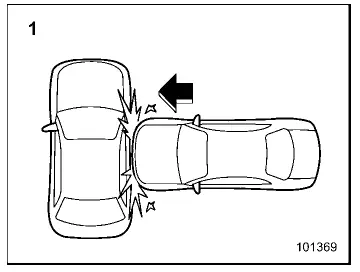
- A significant side impact occurring near the front seating area of the Subaru Ascent.
Examples of the types of accidents in which the SRS curtain airbag will most likely deploy
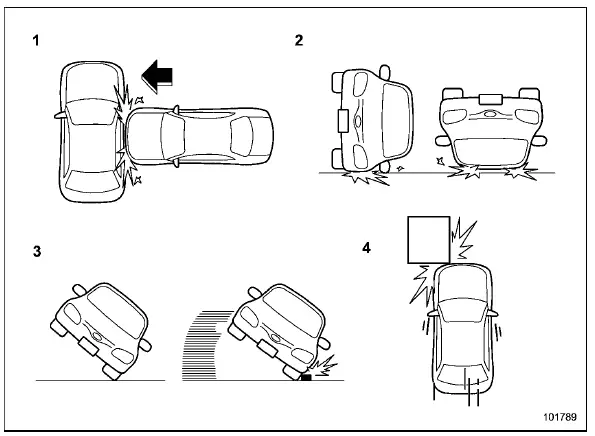
- A severe side impact affecting either the front or rear seating zones of the Subaru Ascent.
- A rollover event where the vehicle tips onto its side or roof.
- Situations where the vehicle tilts at a critical angle or when lateral force is applied, such as striking a curb during skidding.
- An offset frontal collision strong enough to activate the Subaru Ascent frontal airbag system.
Examples of the types of accidents in which it is possible that the SRS side airbag and the SRS curtain airbag will deploy
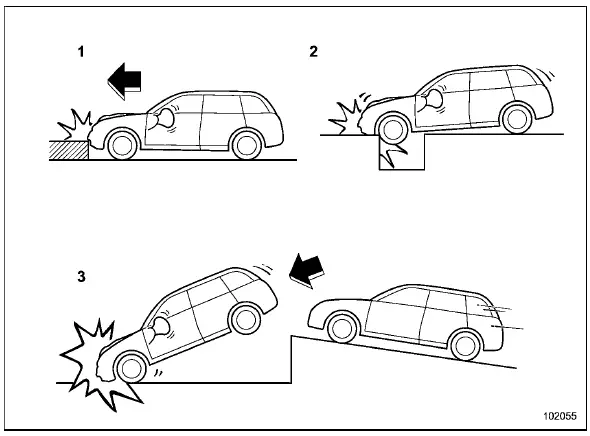
- Impact with a curb, road edge, or other hard surface.
- The Subaru Ascent dropping into or jumping over a deep pothole or uneven terrain.
- A hard landing or sudden vertical impact caused by the vehicle becoming airborne.
In the Subaru Ascent, significant impacts affecting the underbody can also trigger deployment of the SRS side and curtain airbags, as the system interprets these forces as potentially dangerous to occupants.
Understanding these Subaru Ascent airbag deployment scenarios allows drivers and passengers to better appreciate how the system responds in different crash conditions and reinforces the importance of proper seating position and seatbelt usage at all times.
Several representative scenarios are illustrated below to help better understand how the Subaru Ascent SRS airbag system behaves under different collision conditions.
Examples of the types of accidents in which the SRS side airbag is unlikely to deploy
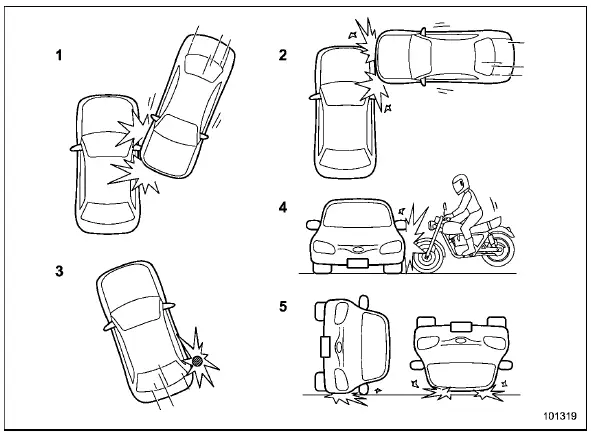
- The Subaru Ascent experiences an angled (oblique) side impact that does not transfer sufficient force directly into the passenger compartment.
- The vehicle is struck on the side in an area located outside the main passenger cabin structure.
- The Subaru Ascent collides with a narrow object such as a telephone pole or similar fixed structure.
- The vehicle sustains a side impact from a motorcycle or another lightweight object.
- The Subaru Ascent rolls onto its side or roof without the specific side-impact conditions required for side airbag deployment.
In many real-world situations, collisions may not generate the level or direction of force necessary to trigger the Subaru Ascent SRS side airbag. Even in accidents that appear significant, deployment depends strictly on sensor data and impact dynamics.
Examples of the types of accidents in which the SRS curtain airbag is unlikely to deploy
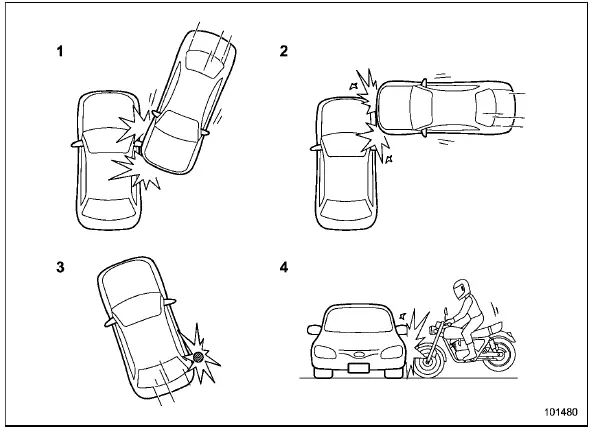
- An oblique side impact where force is distributed in a way that does not meet deployment thresholds.
- A side collision occurring outside the primary occupant protection zone of the Subaru Ascent cabin.
- Impact with narrow, rigid objects such as poles that do not transmit sufficient lateral force across the structure.
- A side impact involving a motorcycle or similarly small vehicle.
As with side airbags, the Subaru Ascent SRS curtain airbags may not deploy in certain collisions if the force, angle, or location of impact does not meet the system’s activation criteria.
Examples of the types of accidents in which the SRS side airbag and SRS curtain airbag are not designed to deploy in most cases
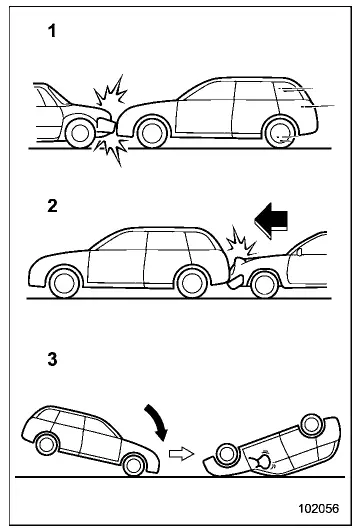
- The Subaru Ascent is involved in a frontal collision with another vehicle, whether moving or stationary.
- The vehicle is struck from the rear by another vehicle.
- The Subaru Ascent experiences a rollover sequence where the vehicle flips end over end rather than a lateral rollover condition.
In these types of collisions, the Subaru Ascent SRS side and curtain airbags are generally not intended to deploy, as they would not provide effective protection for occupants under such circumstances.
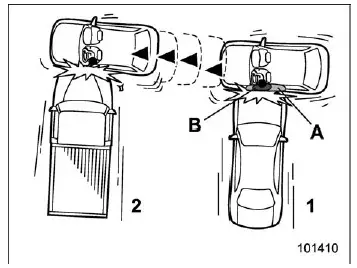
- First impact
- Second impact
- SRS curtain airbag
- SRS side airbag
In the Subaru Ascent, both the SRS side airbag and SRS curtain airbag are designed for single deployment only, even if the vehicle is subjected to multiple impacts in quick succession.
For example, in a double side-impact collision—where the Subaru Ascent is struck from the side and then immediately hit again from the same direction—the airbags will deploy during the first impact only. Once activated, the system will not deploy again for subsequent impacts within the same incident.
Understanding these Subaru Ascent deployment limitations is essential for correctly interpreting airbag behavior and reinforces the importance of seatbelt use as the primary safety restraint in all driving conditions.
 Example of the type of accident
The Subaru Ascent is equipped with an advanced SRS frontal airbag system engineered
to provide effective protection during specific types of collisions. The driver's
and front passenger's ...
 SRS airbag system monitors
SRS airbag system warning light
The Subaru Ascent is equipped with an advanced diagnostic monitoring system that
continuously checks the readiness and functionality of the SRS airbag system, in ...
Other materials:
Preparation tool
CONTROL SYSTEMS > General DescriptionPREPARATION TOOL1. SPECIAL TOOLILLUSTRATIONTOOL NUMBERDESCRIPTIONREMARKS — SUBARU SELECT MONITOR 4Used for setting of each function and troubleshooting for electrical system.NOTE:For detailed operation procedures of Subaru Select Monitor 4, refer to “A ...
Inspection
FUEL INJECTION (FUEL SYSTEMS)(H4DO) > Knock SensorINSPECTION1. Check that the knock sensor has no deformation, cracks or other damages.2. Measure the resistance between knock sensor terminals.Terminal No.Standard1 and 2560±28 k? ...
Relay and fuse
Inspection
Blind Spot Detection/Rear Cross Traffic Alert > Relay and FuseINSPECTION1. CHECK FUSE1. Remove the fuse and inspect visually.2. If the fuse is blown out, replace the fuse.NOTE:If the fuse is blown again, check the system wiring harness. Location
Blind Spot Detection/Rear Cross Traffi ...
