
Subaru Crosstrek Service Manual: Inspection
MECHANICAL(H4DO) > Cam Carrier
INSPECTION
1. Visually check the cam carrier filter, and if clogging is found, replace with a new part.
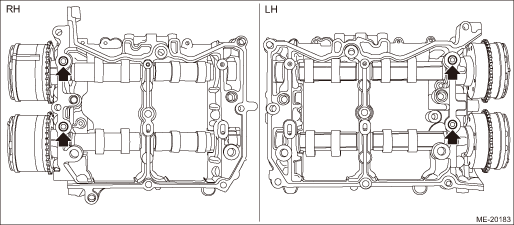
2. Check the camshaft journals for damage and wear. Replace the camshaft if faulty.
3. Check the cam face condition of camshaft, and remove the minor faults by grinding with oil stone. Replace the camshaft if uneven wear is found.
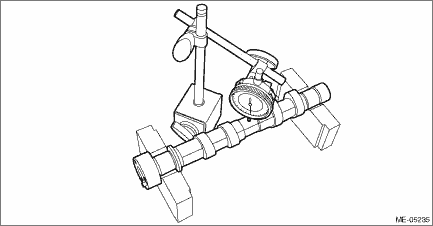
4. Using a dial gauge, check the camshaft bend. If it exceeds the limit, replace the camshaft.
NOTE:
Measurement should be performed at a temperature of 20°C (68°F).
Camshaft bend:
Limit
0.020 mm (0.0008 in)
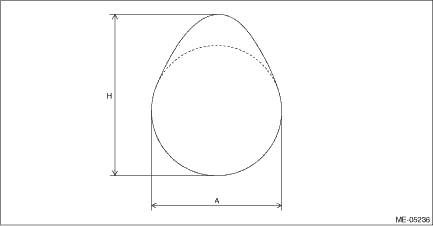
5. Check the cam lobe height “H” and cam base circle diameter “A” of camshaft as shown in the figure, using micrometer. If it is not within the standard, replace the camshaft.
NOTE:
Measurement should be performed at a temperature of 20°C (68°F).
Camshaft cam lobe overall height H:
Intake
Standard
40.34 — 40.44 mm (1.588 — 1.592 in)
Exhaust
Standard
39.66 — 39.76 mm (1.561 — 1.565 in)
Camshaft cam base circle diameter A:
Standard
34.0 mm (1.339 in)
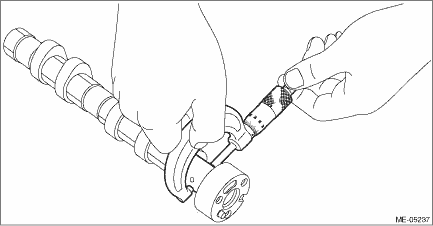
6. Check the camshaft journal outer diameter using micrometer. If it is not within the standard, replace the camshaft.
NOTE:
• Measurement should be performed at a temperature of 20°C (68°F).
• Measure outer diameter of each journal at several points, and read the value of most worn location.
Camshaft journal outer diameter:
Standard
25.946 — 25.963 mm (1.0215 — 1.0222 in)
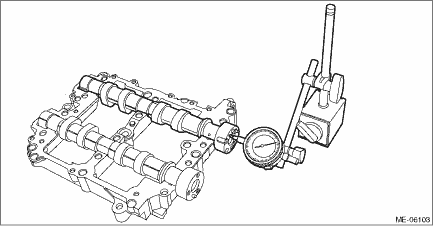
7. Using a dial gauge, check the thrust clearance of the camshaft. If it is not within the standard or if uneven wear is found, replace each camshaft cap and cam carrier as a set. If necessary replace the camshaft.
NOTE:
• Measurement should be performed at a temperature of 20°C (68°F).
• Set the dial gauge at end surface of camshaft.
Camshaft thrust clearance:
Standard
0.068 — 0.116 mm (0.0027 — 0.0047 in)
8. Check the oil clearance on the camshaft using a plastigauge.
NOTE:
Measurement should be performed at a temperature of 20°C (68°F).
(1) Remove the liquid gasket from cam carrier and front camshaft cap, intake rear camshaft cap and exhaust rear camshaft cap.
(2) Clean each camshaft cap and cam carrier journals.
(3) Set the camshaft to the cam carrier.
(4) Place a plastigauge across the camshaft journals of each camshaft and set the camshaft caps.
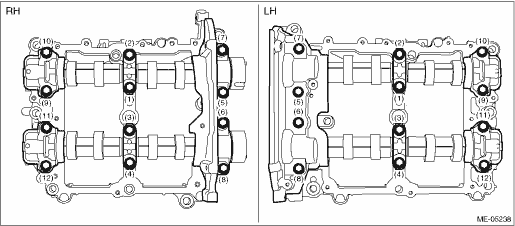
(5) Tighten the bolts which secure front camshaft cap, intake center camshaft cap, intake rear camshaft cap, exhaust center camshaft cap and exhaust rear camshaft cap in numerical order as shown in the figure.
Tightening torque:
18 N·m (1.8 kgf-m, 13.3 ft-lb)
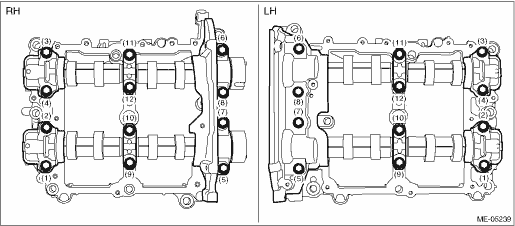
(6) Loosen the bolts (front camshaft cap, intake center camshaft cap, intake rear camshaft cap, exhaust center camshaft cap and exhaust rear camshaft cap) equally, a little at a time in numerical sequence as shown in the figure, and remove each camshaft cap.
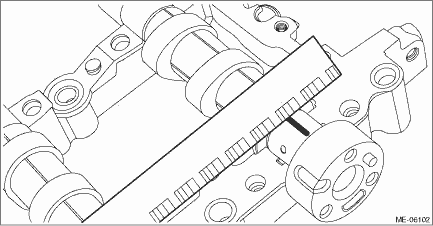
(7) Determine camshaft oil clearance by matching the widest point of plastigauge on each journal against scale printed on a package of plastigauge. If it is not within the standard, replace each camshaft cap and cam carrier as a set. If necessary replace the camshaft.
Camshaft oil clearance:
Standard
0.037 — 0.072 mm (0.0015 — 0.0028 in)
(8) Completely remove the plastigauge.
 Disassembly
MECHANICAL(H4DO) > Cam CarrierDISASSEMBLY1. CAM CARRIER RH1. Loosen the bolts (front camshaft cap RH, intake center camshaft cap RH, intake rear camshaft cap RH, exhaust center camshaft cap RH, and ...
 Installation
MECHANICAL(H4DO) > Cam CarrierINSTALLATION1. CAM CARRIER RH1. Insert the steel rods into ST, and set the engine so that the camshaft RH is facing up.CAUTION:• If the engine is standing on one ...
Other materials:
Inspection
LAN SYSTEM (DIAGNOSTICS) > General DescriptionINSPECTION1. INSPECTION WITHOUT USING CAN DIAGNOSTICBefore performing diagnosis, check the following items that might affect troubles of each module.1. Check the battery. Battery > INSPECTION">2. Check the fuse condition.Make sure that amp ...
Basic diagnostic procedure Procedure
CONTINUOUSLY VARIABLE TRANSMISSION (DIAGNOSTICS) > Basic Diagnostic ProcedurePROCEDURESTEPCHECKYESNO1.CHECK PRE-INSPECTION.1) Ask the customer when and how the trouble occurred using the interview check list. Check List for Interview">2) Before performing diagnostics, check the following ...
CHECK ENGINE warning light/Malfunction indicator light
CAUTION
If the CHECK ENGINE warning light in your Subaru Ascent turns on while driving,
it is essential to have the vehicle inspected and repaired by an authorized SUBARU
dealer as soon as possible. Continuing to operate the Subaru Ascent without addressing
potential emission control system i ...
