
Subaru Crosstrek Owners Manual: Tire pressure monitoring system (TPMS) (U.S.-spec. models)
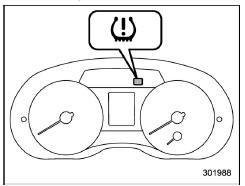
Low tire pressure warning light (type A)
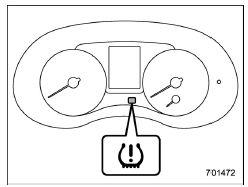
Low tire pressure warning light (type B)
The tire pressure monitoring system provides the driver with the warning message indicated by sending a signal from a sensor that is installed in each wheel when tire pressure is severely low.
The tire pressure monitoring system will activate only when the vehicle is driven.
Also, this system may not react immediately to a sudden drop in tire pressure (for example, a blow-out caused running over a sharp object).
WARNING
If the low tire pressure warning light illuminates while driving, never brake suddenly. Instead, perform the following procedure.
Otherwise an accident involving serious vehicle damage and serious personal injury could occur.
(1) Keep driving straight ahead while gradually reducing speed.
(2) Slowly pull off the road to a safe place.
(3) Check the pressure for all four tires and adjust the pressure to the COLD tire pressure shown on the vehicle placard on the door pillar on the driver's side.
If this light still illuminates while driving after adjusting the tire pressure, a tire may have significant damage and a fast leak that causes the tire to lose air rapidly.
If you have a flat tire, replace it with a spare tire as soon as possible.
- When a spare tire is mounted or a
wheel rim is replaced without the
original pressure sensor/transmitter
being transferred, the low
tire pressure warning light will
illuminate steadily after blinking
for approximately one minute.
This indicates the TPMS is unable to monitor all four road wheels. Contact your SUBARU dealer as soon as possible for tire and sensor replacement and/ or system resetting.
- When a tire is repaired with liquid
sealant, the tire pressure warning
valve and transmitter may not
operate properly. If a liquid sealant
is used, contact your nearest
SUBARU dealer or other qualified
service shop as soon as possible.
Make sure to replace the tire pressure warning valve and transmitter when replacing the tire. You may reuse the wheel if there is no damage to it and if the sealant residue is properly cleaned off.
If the light illuminates steadily after blinking for approximately one minute, promptly contact a SUBARU dealer to have the system inspected.
 Changing a flat tire
WARNING
Do not jack up the vehicle on an
incline or a loose road surface.
The jack can come out of the
jacking point or sink into the
ground and this can result in a
severe accident.
...
 Jump starting
WARNING
Battery fluid is SULFURIC ACID.
Do not let it come in contact with
the eyes, skin, clothing or the
vehicle.
If battery fluid gets on you,
thoroughly flush the exposed
area ...
Other materials:
Removal
SUNROOF/T-TOP/CONVERTIBLE TOP (SUNROOF) > Sunroof AssemblyREMOVALCAUTION:• Before handling the airbag system components, refer to “CAUTION” of “General Description” in “AIRBAG SYSTEM”. General Description > CAUTION">• When removing the c ...
Refrigerant charging procedure Procedure
HVAC SYSTEM (HEATER, VENTILATOR AND A/C) > Refrigerant Charging ProcedurePROCEDURECAUTION:• While working, be sure to wear protective goggles and protective gloves.• Air in the cycle can cause insufficient air conditioning, and water in the cycle can cause clogging in the cycle (icing ...
Removal
CONTINUOUSLY VARIABLE TRANSMISSION(TR580) > CVTF FilterREMOVALNOTE:• Although CVTF filter is a maintenance-free part, replace it if a large quantity of wear debris and metal particles are found in CVTF and CVTF filter.• For removal of CVTF filter, refer to “Transmission Case&rdq ...
