
Subaru Ascent 2018-2026 Owner's Manual: Third-row seats
In the Subaru Ascent, all third-row seating positions are equipped with head restraints designed to enhance passenger protection and comfort. These head restraints can be adjusted easily to ensure proper support and optimal safety during travel.
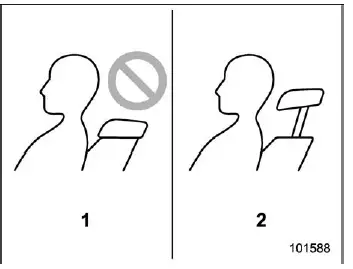
- When not used (retracted position)
- When used (extended position)
CAUTION
The head restraint in the Subaru Ascent must not be used in the fully retracted position.
Before occupying the seat, always raise the head restraint to the extended position to ensure proper head and neck support.
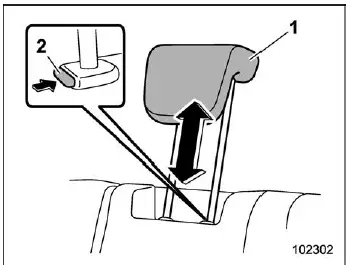
- Head restraint
- Release button
To raise: Pull the head restraint upward until it locks securely into place.
To lower: Press the release button located on the upper portion of the seatback and gently push the head restraint downward.
To remove: While pressing the release button, pull the head restraint completely out of the seatback guides.
To install: Insert the head restraint into the mounting holes at the top of the seatback in the Subaru Ascent until it locks securely. Press and hold the release button if further adjustment is needed.
When the third-row seat in the Subaru Ascent is occupied, always keep the head restraint in the extended position. When the seat is not in use, it can be lowered to improve rearward visibility for the driver.
 Head restraints
The head restraint system in the Subaru Ascent is an essential safety feature
designed to reduce the risk of neck and spinal injuries during rear-end collisions.
Proper adjustment and correct usag ...
 Seat heater
The seat heater system in the Subaru Ascent operates when the ignition switch
is in the "ON" position, providing additional comfort during cold weather conditions.
CAUTION
Do not plac ...
Other materials:
Preparation tool
SEAT BELT SYSTEM > General DescriptionPREPARATION TOOL1. SPECIAL TOOL• SUBARU SELECT MONITORILLUSTRATIONTOOL NUMBERDESCRIPTIONREMARKS — SUBARU SELECT MONITOR 4Used for setting of each function and troubleshooting for electrical system.NOTE:For detailed operation procedures of Subaru Selec ...
Dtc b14e9 intake door actuator circuit open
HVAC SYSTEM (AUTO A/C) (DIAGNOSTICS) > Diagnostic Procedure with Diagnostic Trouble Code (DTC)DTC B14E9 INTAKE DOOR ACTUATOR CIRCUIT OPENDTC detecting condition:Intake door actuator potentiometer circuit is open.Trouble symptom:FRESH/RECIRC does not operate.Wiring diagram:Air conditioning system ...
Installation
MECHANICAL(H4DO) > Cam CarrierINSTALLATION1. CAM CARRIER RH1. Insert the steel rods into ST, and set the engine so that the camshaft RH is facing up.CAUTION:• If the engine is standing on one side without inserting the steel rod into ST, engine may lose balance and fall down. Be sure to ins ...
