
Subaru Crosstrek Service Manual: Removal
FUEL INJECTION (FUEL SYSTEMS)(H4DO) > Fuel Tank
REMOVAL
WARNING:
Place “NO OPEN FLAMES” signs near the working area.
CAUTION:
• Be careful not to spill fuel.
• Catch the fuel from the tubes using a container or cloth.
1. Release the fuel pressure. Fuel > PROCEDURE">
2. Drain fuel. Fuel > PROCEDURE">
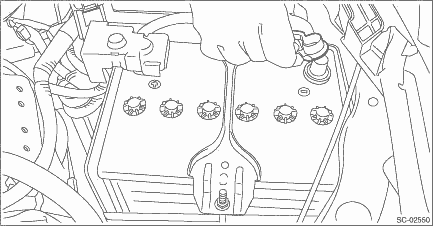
3. Disconnect the ground cable from battery.
4. Remove the rear seat cushion. Rear Seat > REMOVAL">
5. Remove the service hole cover of fuel pump.
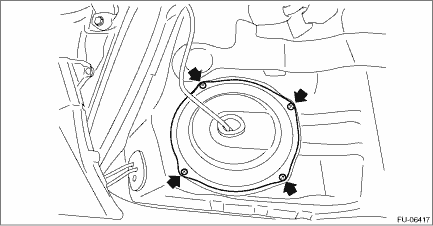
6. Disconnect connectors from the fuel pump, and move aside the service hole cover.

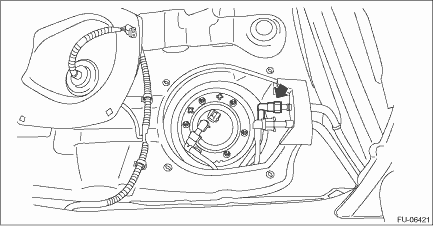
7. Remove the service hole cover of fuel sub level sensor.

8. Disconnect connectors from the fuel sub level sensor, and move aside the service hole cover.
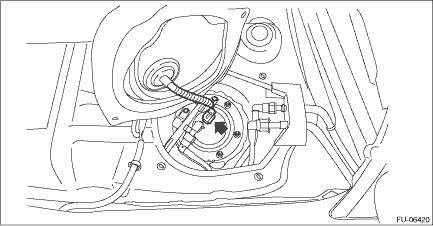
9. Disconnect the quick connector on the fuel delivery tube.
NOTE:
Disconnect the quick connector as shown in the figure.

(a) | Slider |
10. Lift up the vehicle.
11. Remove the rear exhaust pipe and muffler. Rear Exhaust Pipe > REMOVAL"> Muffler > REMOVAL">
12. Remove the rear differential. Rear Differential (T-type) > REMOVAL"> Rear Differential (VA-type) > REMOVAL">
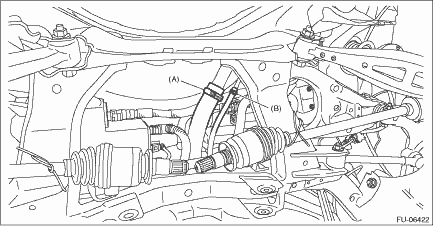
13. Disconnect the fuel filler hose (A) and evaporation hose (B) from the fuel filler pipe assembly.
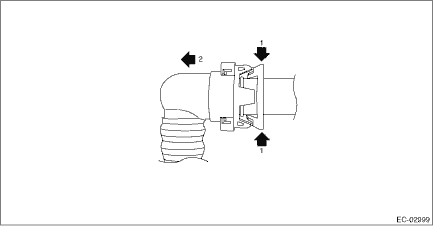
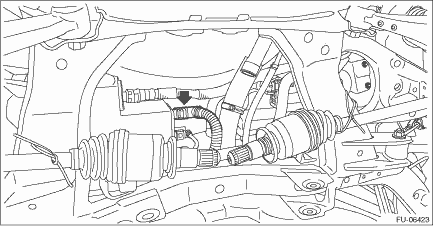
14. Disconnect the vent tube from canister.
NOTE:
Disconnect the quick connector as shown in the figure.
15. Remove the fuel tank protector. Fuel Tank Protector > REMOVAL">
16. Remove the heat shield cover and stopper.
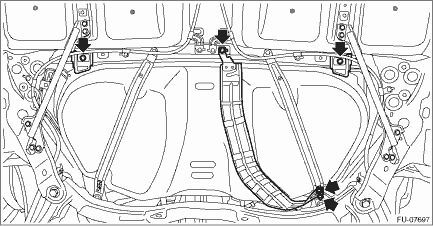
17. Remove the stay - rear frame COMPL.
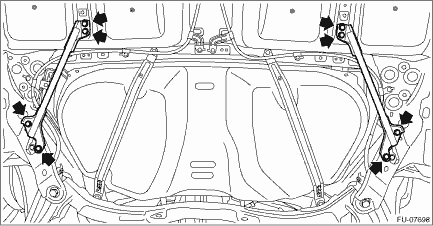
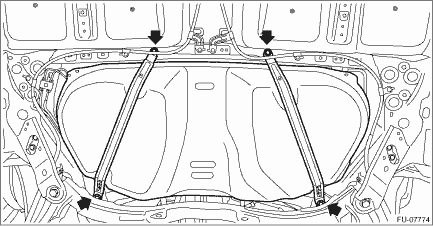
18. Support the fuel tank with a transmission jack, remove the bolts from the fuel tank band, and remove the fuel tank from the vehicle.
WARNING:
• A helper is required to perform this work.
• Fuel may remain in the fuel tank. This will cause the left and right sides to be unbalanced. Be careful not to drop the fuel tank.
 Inspection
FUEL INJECTION (FUEL SYSTEMS)(H4DO) > Fuel TankINSPECTION1. Check that the fuel tank and fuel pipe have no deformation, cracks and other damages.2. Check that the fuel hose and tube have no cracks, ...
 Installation
FUEL INJECTION (FUEL SYSTEMS)(H4DO) > Fuel TankINSTALLATION1. Support the fuel tank with a transmission jack, set the fuel tank in place, and temporarily tighten the bolts of the fuel tank band.WAR ...
Other materials:
Assembly
GLASS/WINDOWS/MIRRORS > Outer Mirror AssemblyASSEMBLYCAUTION:• Be careful not to catch the harness in between the parts.• When installing the mirror - repair, insert the connector and clip securely.1. Install the light assembly - side turn mirror.2. Install the cover - cap outer mirro ...
Removal
WIPER AND WASHER SYSTEMS > Front Wiper Motor and LinkREMOVAL1. Disconnect the ground cable from battery. NOTE">2. Remove the arm assembly - windshield wiper. Front Wiper Arm > REMOVAL">3. Remove the cowl panel assembly. Cowl Panel > REMOVAL">CAUTION:Before removin ...
Stall test Inspection
CONTINUOUSLY VARIABLE TRANSMISSION(TR580) > Stall TestINSPECTIONCAUTION:Make sure no other person is around the vehicle during stall test measurement.NOTE:Stall test is extremely important in diagnosing the condition of CVT and engine. The test is necessary to measure the engine stall speeds in & ...
