
Subaru Crosstrek Service Manual: Procedure
HVAC SYSTEM (HEATER, VENTILATOR AND A/C) > Refrigerant Pressure with Manifold Gauge Set
PROCEDURE
1. REFRIGERANT GAS PRESSURE INSPECTION
1. Prepare the vehicle.
NOTE:
Check that the ambient temperature is 25 — 40°C (77 — 104°F) and that the humidity is 30% — 80%.
• Place the vehicle in the shade and windless condition, and open the front hood.
• Open the front windows and close all doors.
2. Check the refrigerant pressure.
Preparation tool:
Manifold gauge set
(1) Connect the manifold gauge set, and start the engine.
(2) Set the vehicle to the following conditions.
Item | Condition |
Engine | Warmed up (Engine coolant temperature indicator light: OFF) |
Air vent grille | Shutter is fully open. |
A/C switch | ON |
Temperature adjustment dial | LO (MAX COOL) |
FRESH/RECIRC switch | RECIRC |
Air flow control dial or switch | VENT |
Fan dial | Auto A/C model: 5/7 level |
Manual A/C model: 3/4 level |
(3) In the condition of step (2), idle the engine for 30 minutes.
(4) Read the gauge values on both high pressure side and low pressure side for manifold gauge.
3. Measure the air vent grille outlet opening temperature, ambient temperature and humidity.
Preparation tool:
Thermometer and hygrometer
NOTE:
For outlet opening temperature, measure the average temperature of center grille assembly and side grille assembly.
4. Check that the high and low pressures and outlet opening temperature for ambient temperature and humidity is within the standard value described in the chart below.
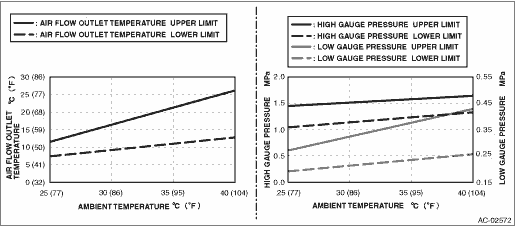
5. Refer to “DIAGNOSIS WITH SYMPTOM” if the inspection result is not within the standard value. Refrigerant Pressure with Manifold Gauge Set > INSPECTION">
 Inspection
HVAC SYSTEM (HEATER, VENTILATOR AND A/C) > Refrigerant Pressure with Manifold Gauge SetINSPECTION1. INSPECTION WITH PRESSURE SYMPTOMSSymptomsReferenceBoth high and low pressure sides are low. Refri ...
 Relay and fuse
...
Other materials:
Tire pressure monitoring system (TPMS) (if equipped)
The tire pressure monitoring system provides
the driver with a warning message
by sending a signal from a sensor that is
installed in each wheel when tire pressure
is severely low. The tire pressure monitoring
system will activate only when the
vehicle is driven. Also, this system may
not rea ...
Installation
DIFFERENTIALS > Rear Differential Front MemberINSTALLATION1. Install the rear differential front member, and temporarily attach and tighten a new self-locking nut.2. Remove the transmission jack.3. Tighten the self-locking nut.Tightening torque:T1: 50 N·m (5.1 kgf-m, 36.9 ft-lb)T2: 110 N&m ...
Inspection
CLUTCH SYSTEM > Release Bearing and LeverINSPECTION1. RELEASE BEARINGCAUTION:Since this bearing is grease-sealed and is a non-lubrication type, do not wash with gasoline or any other solvent when servicing the clutch.1. Check the bearing for smooth movement by applying force to the bearing in the ...
