
Subaru Crosstrek Service Manual: Inspection
CONTINUOUSLY VARIABLE TRANSMISSION(TR580) > Transfer Clutch
INSPECTION
• Inspect the drive plate facing for wear and damage.
• Driven plate for discoloration (burned color)
• Make sure the snap ring is not worn and the return spring has no permanent distortion, damage, or deformation.
• Check the lip seal for damage.
• Inspect the extension end play, and adjust it to within the standard value. Transfer Clutch > ADJUSTMENT">
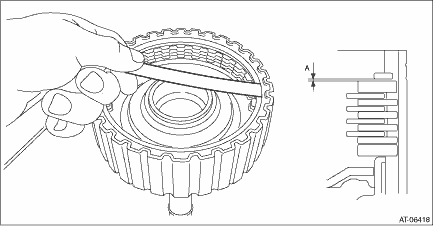
1. Before measuring clearance “A” between snap ring and driven plate, place same thickness shims on both sides to prevent the plate from tilting.
2. When clearance “A” exceeds the limit for use, replace the drive plate and driven plate as a set, and select the pressure plate within the initial specified value.
Initial standard:
0.7 — 1.1 mm (0.028 — 0.043 in)
Limit thickness:
1.3 mm (0.051 in)
3. Check for tight corner braking phenomenon when the vehicle is moved forward with the steering fully turned. If tight corner braking occurs, perform the following procedures.
(1) With the steering wheel held at fully turned position, drive the vehicle in “D” range and with vehicle speed at approx. 5 km/h (3 MPH) in both clockwise and counterclockwise directions for approx. ten times each, while repeating acceleration and braking intermittently.
(2) If the tight corner braking phenomenon still persists, drive the vehicle again in a circle for several laps.
 Disassembly
CONTINUOUSLY VARIABLE TRANSMISSION(TR580) > Transfer ClutchDISASSEMBLY1. Remove the snap ring, and then remove the pressure plate, drive plate and driven plate.(A)Snap ring2. Compress the return sp ...
 Installation
CONTINUOUSLY VARIABLE TRANSMISSION(TR580) > Transfer ClutchINSTALLATION1. Install the thrust bearing.NOTE:Make sure to install in the right direction.2. Install the transfer clutch assembly.3. Sele ...
Other materials:
Dtc b1860 short in driver s knee airbag
AIRBAG SYSTEM (DIAGNOSTICS) > Diagnostic Chart with Trouble CodeDTC B1860 SHORT IN DRIVER’S KNEE AIRBAGDiagnosis start condition:Ignition voltage is 10 V to 16 V.DTC detecting condition:• Airbag main harness circuit is shorted.• Knee airbag module harness circuit is shorted.&bul ...
Dtc p0756 shift solenoid "b" performance/stuck off
CONTINUOUSLY VARIABLE TRANSMISSION (DIAGNOSTICS) > Diagnostic Procedure with Diagnostic Trouble Code (DTC)DTC P0756 SHIFT SOLENOID "B" PERFORMANCE/STUCK OFFDTC detecting condition:Detected when two consecutive driving cycles with fault occur.Trouble symptom:• Acceleration is poor ...
Replacement
CONTINUOUSLY VARIABLE TRANSMISSION(TR580) > Extension Case Oil SealREPLACEMENTCAUTION:Immediately after the vehicle has been running or after idling for a long time, the CVTF will be hot. Be careful not to burn yourself.1. Lift up the vehicle.2. Remove the center exhaust pipe. Center Exhaust Pip ...
