
Subaru Crosstrek Service Manual: Inspection
CLUTCH SYSTEM > Release Bearing and Lever
INSPECTION
1. RELEASE BEARING
CAUTION:
Since this bearing is grease-sealed and is a non-lubrication type, do not wash with gasoline or any other solvent when servicing the clutch.
1. Check the bearing for smooth movement by applying force to the bearing in the radial direction.
Radial direction stroke:
1.4 mm (0.055 in) or more
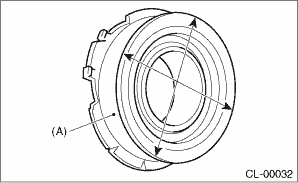
(A) | Bearing case |
2. While applying force to the bearing in the rotational direction, check the bearing for smooth rotation.
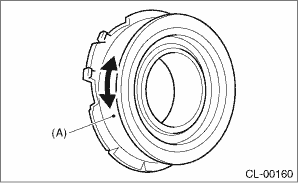
(A) | Bearing case |
3. Check for wear and damage at the bearing case surface in contact with the lever.
2. RELEASE LEVER
Check the pivot portion of the lever and the contact area with the release bearing case for wear.
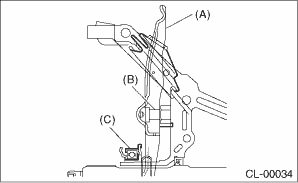
(A) | Release lever |
(B) | Pivot |
(C) | Release bearing |

 Removal
CLUTCH SYSTEM > Release Bearing and LeverREMOVAL1. Remove the transmission assembly from the vehicle. Manual Transmission Assembly > REMOVAL">2. Remove the two clips from the release lev ...
Other materials:
Removal
REAR SUSPENSION > Front Lateral LinkREMOVAL1. Lift up the vehicle, and then remove the rear wheels.2. Remove the bolts and nuts, and then remove the trailing link.3. Remove the lateral link assembly - front.(1) Remove the snap pin (a) and nut (b).(2) Remove the ball joint from the housing assembl ...
Removal
SECURITY AND LOCKS > Rear Gate Opener ButtonREMOVALNOTE:• The button - opener rear gate is integrated with the rear lock button. (Model with keyless access with push button start)• Open the panel - rear gate before disconnecting the ground terminal from the battery.1. Disconnect the g ...
Immobilizer
The immobilizer system is designed to
prevent an unauthorized person from
starting the engine. Only keys registered
with your vehicle's immobilizer system can
be used to operate your vehicle. This
system, however, is not a 100% anti-theft
guarantee.
For models with "keyless access with
pus ...
